The Surfing Entrepreneur Paradise Guide: Where to Build a Startup, Surf World-Class Waves, and Live Free Across 12 Nations
The definitive operational field manual for founders, software engineers, and digital nomads who refuse to compromise between scaling venture-grade businesses and surfing world-class waves.
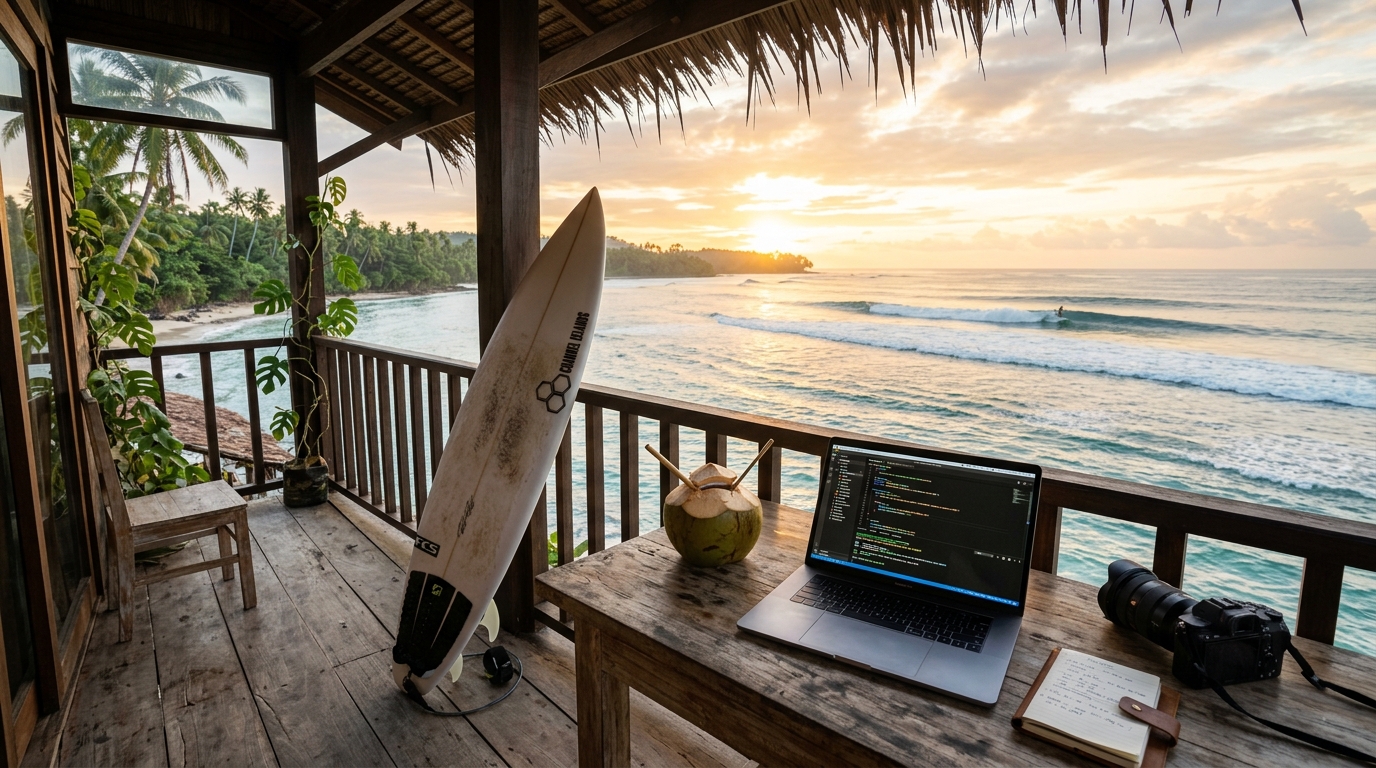
📑 Master Guide Navigation & Blueprint
- 1. Portugal (Ericeira, Peniche, Algarve)
- 2. Spain (Basque, Cantabria, Canaries)
- 3. Indonesia (Bali Bukit/Canggu & Lombok)
- 4. Philippines (Siargao, La Union, Baler)
- 5. Thailand (Phuket & Khao Lak)
- 6. Japan (Chiba, Shonan, Miyazaki)
- 7. Taiwan (Taitung, Yilan, Kenting)
- 8. Vietnam (Da Nang & Mui Ne)
- 9. Malaysia (Cherating & Tioman)
- 10. South Korea (Yangyang, Jeju, Busan)
- 11. UAE (Surf Abu Dhabi & Dubai)
- 12. Singapore (Trifecta & Regional Hub)
The Asymmetric Advantage of the Surfing Founder
Mainstream startup mythology glorifies 14-hour sedentary grinds in fluorescent-lit cubicles. Yet, the world's most resilient independent founders, technical architects, and remote bootstrappers operate under an entirely different paradigm: asymmetric high-performance living.
Surfing is not an escape from ambitious intellectual work; it is the ultimate cognitive and biological accelerator. When you align your daily schedule with the thermodynamic laws of the ocean, you unlock structural advantages that urban competitors cannot replicate:
🌊 Thermodynamic Land-Breeze Physics
Coastal physics dictates that night-time terrestrial cooling creates high air pressure over land relative to the sea, generating clean, glassy offshore winds at first light. By rising with the dawn patrol, you catch world-class conditions before noon onshore sea breezes arrive.
🧠 Transient Hypofrontality & Flow State
In heavy breaking surf, survival demands 100% sensory immersion. The prefrontal cortex—home of neurotic rumination and email anxiety—temporarily deactivates. Flooding the brain with dopamine, norepinephrine, and BDNF resets executive focus for subsequent 4-hour coding sprints.
⚡ Volatility Conditioning & Hold-Down Calm
Surfing trains rapid, low-latency decision making: committing to a vertical drop eliminates analysis paralysis. Surviving an 8-foot cleanup set underwater conditions the autonomic nervous system to stay calm when critical production servers drop or startup revenue fluctuates.
Section 1: The Daily Operating System & Hardware Go-Bag
Operating a high-scale technology enterprise from a remote coastline requires engineering discipline. You must protect your physical vehicle, guard your electronics from airborne salt corrosion, and manage global timezones with zero latency.
1.1 The Chronological 24-Hour Operating Schedule
05:30 - 07:30 | DAWN PATROL OCEAN MASTERY. Anaerobic paddle sprints, wave reading, flow-state activation.
07:30 - 08:30 | Biological Reset: Fresh-water desalination, 50/50 otic alcohol rinse, 35g protein refuel, review MIT.
08:30 - 13:00 | DEEP-WORK SPRINT 1 (4.5 hrs). High cognitive load (systems architecture, coding). Zero Slack.
13:00 - 14:30 | Mid-day Bio-Reset: Nutrient-dense lunch, 20-min NSDR/nap, thoracic foam roller mobility.
14:30 - 18:00 | DEEP-WORK SPRINT 2 & ASYNC OPS (3.5 hrs). Pull requests, client calls, team unblocking.
18:00 - 19:30 | Sunset walk, 8-min rotator cuff prehab, anti-inflammatory dinner (wild fish/papaya).
21:30 - 05:00 | Total screen blackout, air-conditioned cool dark room, 7.5 to 8.0 hrs restorative sleep.
1.2 Global Timezone Arbitrage Framework
Living in global surf havens provides asymmetric advantages when you align asynchronous operations with counterpart markets:
- Southeast Asia & Taiwan (GMT+8 - Bali, Siargao, Taitung): Complete morning silence for deep building. London and European headquarters wake up as you finish your 4.5-hour sprint (14:00 local = 07:00 London), giving you a 3-hour overlap window for live executive syncs before dinner.
- Southern Europe (GMT+0/+1 - Ericeira, Zarautz, Canaries): Morning European focus aligns with local daylight. In the afternoon (14:00–18:00 local), you unlock seamless real-time overlap with New York (09:00–13:00 EDT) and California (06:00–10:00 PDT) without burning midnight oil.
1.3 The Coastal Hardware Go-Bag & Corrosion Defense
Air within 1 km of breaking ocean waves carries microscopic sodium chloride droplets. Combined with 85%+ relative humidity and 30°C heat, salt air oxidizes logic boards and destroys USB ports within months if unprotected.
| Gear Item | Model Recommendation | Tactical Specification | Coastal Resilience Function |
|---|---|---|---|
| Airtight Case | Pelican Air 1535 (TrekPak) | IP67 submersible, pressure valve | Hermetic seal locks out salt spray and fine quartz sand. |
| Active Desiccant | 2x 50g Metal Silica Canisters | Color-indicating (orange to green) | Bake in oven to regenerate; keeps internal RH below 45%. |
| Satellite Uplink | SpaceX Starlink Mini | Built-in Wi-Fi 5, 25-40W DC draw | Runs off USB-C PD barrel cable for 8 hrs on battery; bypasses cuts. |
| LiFePO4 Power | Anker Solix C300 DC (288Wh) | 3,000+ life cycles, dual 140W PD | Thermal stability in direct equatorial sun; powers Starlink & Mac. |
| Cellular Edge | GL.iNet Spitz AX (GL-X3000) | 5G Dual-SIM with ping failover | Pings 1.1.1.1 every 5s; automatic instant switch to backup SIM. |
| Physical Port Plugs | Silicone Dust Plug Sets | USB-C, MagSafe, 3.5mm seals | Prevents sodium chloride crusting inside unused computer ports. |
1.4 Athletic Longevity & Surfer's Medical Defense
Paddling stresses internal rotators (lats, pecs). Longevity demands strengthening the external rotators: execute 3 sets of 15 banded face pulls with external rotation and prone Y-T-W-L raises daily to stop supraspinatus impingement.
Typing rounds the thoracic spine. If your upper back is stiff, your lumbar spine hyperextends to hold your head up while paddling, crushing L4-L5 discs. Perform 10 slow passes over a high-density foam roller (T4-T8) before paddling.
Cold ocean water (<19°C) and wind trigger benign bone growth inside the ear canal that can close the canal completely. Wear acoustic plugs (SurfEars 3.0) in cold waters, and apply 2 drops of 50% isopropyl alcohol / 50% white vinegar post-surf to desiccate moisture and restore acidic pH.
Avoid chemical sunscreens (oxybenzone/octinoxate) that bleach coral reefs and sting eyes during duck-dives. Use opaque mineral zinc sticks with a beeswax/cocoa butter base (>20% non-nano zinc oxide) that stays intact through 2-hour paddle outs.
Section 2: The 4 Coastal Housing Typologies & Cost Economics
Choosing the wrong accommodation model will either sabotage your venture's output or drain your runway. Coastal real estate breaks into four discrete typologies:
Surf Academy Dorms
Cost: $250–$600/mo (Asia) | $700–$1,150/mo (EU)
Vibe: High communal density, surf shuttles, board storage, coaching clinics.
Trade-off: Acoustic noise, snoring, zero workspace ergonomics, evening Wi-Fi collapse.
Serviced Beach Condos
Cost: $450–$1,400/mo (Asia) | $1,200–$2,200/mo (EU)
Vibe: Modern, private, 100–500Mbps fiber, ergonomic desk space, gym, pool.
Trade-off: Strict HOA rules against boards in elevators; 5–15 min scooter ride to break.
Private Pool Villas
Cost: $1,500–$4,500/mo (Asia) | $3,500–$7,500/mo (EU)
Vibe: Multi-bedroom compounds, plunge pool, lush gardens, team sprint retreats.
Trade-off: High AC cooling bills, tropical pest ingress, capital locked in upfront rent.
Traditional Homestays
Cost: $160–$450/mo (Asia) | $550–$900/mo (EU)
Vibe: Hyper-local immersion, native families, lowest burn rate, secret wave intel.
Trade-off: Sparse non-ergonomic furniture, village rooster noise, unstable water pressure.
2.1 Critical Contractual & Financial Defenses
- The Coastal Salt-Oxidation Deposit Trap: Unscrupulous coastal landlords routinely withhold security deposits by claiming normal marine oxidation on aluminum door tracks and bathroom fittings is tenant-inflicted damage. The Defense: Execute a continuous 10-minute timestamped 4K video walkthrough and macro-photo log of all existing corrosion on Day 1, transmitting an unlisted link to the landlord within 24 hours.
- The Electricity Submetering Arbitrage: In Bali, state utility PLN charges ~1,500 IDR/kWh, yet private landlords routinely bill 2,500 to 3,500 IDR/kWh (a 75% to 108% markup). In Phuket, PEA charges 4.5 THB/kWh, while serviced condos charge 8 to 10 THB/kWh. In Bali, always demand access to the Listrik Pintar pre-paid token meter box to buy 20-digit recharge codes directly via banking apps at government rates.
- Air Conditioning Thermodynamic Penalty: High ambient ocean humidity (85%+) forces split-system AC units to run continuously on dehumidification. Salt-encrusted condenser coils reduce heat rejection by 20%–35%, spiking electricity draw by up to 40%. Keep AC filters washed weekly and set thermostats to 26°C paired with ceiling fans.
- The Mandatory 100Mbps Telecommunications SLA Rider: Never sign a lease without a written clause guaranteeing minimum 100Mbps download / 50Mbps upload speeds with an automatic 72-hour cure period and right of penalty-free rescission if internet stays down over 5 consecutive days.
Section 3: The 12-Nation Comparative Decision Matrix
A comprehensive side-by-side data benchmark comparing all 12 countries where we established living-abroad strategies:
| Nation & Top Hub | Prime Swell Window | Break Character | Water Temp & Rubber | Nomad Visa Pathway | Nomad Monthly Burn | Connectivity |
|---|---|---|---|---|---|---|
| Portugal (Ericeira) | Oct – April (Peak) | World-class reef points & tubes | 13°C–17°C (4/3mm Steamer) | D8 Visa (€3,480/mo) | NHR IFICI | $2,400 – $3,500 | 1Gbps FTTH (92%+) |
| Spain (Basque/Canaries) | Sep – April (Heavy) | Mundaka rivermouth & volcanic slabs | 12°C–20°C (4/3mm North, 3/2mm Canaries) | Teletrabajo (€2,646/mo) | Beckham Law 24% | $1,800 – $2,800 | 1Gbps FTTH (88%+) |
| Bali & Lombok (Indonesia) | May – Oct (Dry Trade) | Shallow coral reefs & cobblestone lefts | 27°C–29°C (Boardshorts year-round) | E33G KITAS ($60k/yr) | B211A | PT PMA | $1,200 – $2,400 | Fiber + Starlink Failover |
| Philippines (Siargao) | Aug – Nov (Cloud 9) | Heavy Pacific reef barrels & sandbars | 28°C–30°C (Boardshorts / Rashguard) | 36-Mo Rolling Tourist | Pending DNV | $1,200 – $2,000 | Starlink + Genset Mandatory |
| Thailand (Phuket/Khao Lak) | May – Oct (SW Monsoon) | Forgiving sandbars & shallow reefs | 28°C–30°C (Boardshorts only) | 5-Year DTV Visa (500k THB savings) | $1,100 – $1,900 | 1Gbps Fiber + 5G |
| Japan (Chiba & Shonan) | Aug – Oct (Typhoon) / Winter | Olympic A-frame beachbreaks & points | 12°C–25°C (5/3mm Winter, Shorts Summer) | 6-Month DNV (¥10M) | Startup Visa | $1,850 – $2,800 | 1-10Gbps FTTH (Tokyo 60m) |
| Taiwan (Taitung / Dulan) | Oct – March (NE Monsoon) | Cobblestone rivermouths & harbor wedges | 22°C–26°C (2mm Top or 3/2mm) | Gold Card (NT$160k/mo, 50% tax cut) | $1,150 – $1,680 | 500Mbps FTTH + 5G |
| Vietnam (Da Nang) | Oct – March (Monsoon) | Consistent sandbar peaks & protected bay | 24°C–26°C (2mm Shorty Dec–Feb) | 90-Day E-Visa (Border runs to Laos) | $900 – $1,400 | 300Mbps Fiber + Ubiquitous Cafes |
| Malaysia (Cherating) | Nov – March exclusively | Long peeling 300m sand point breaks | 28°C–30°C (Boardshorts always) | DE Rantau Pass ($24k/yr income) | $900 – $1,500 | 5G Single Wholesale Network |
| South Korea (Yangyang) | Autumn & Winter (Clean) | Offshore beachbreaks & trendy sandbars | 5°C–25°C (5/4/3mm Hooded Winter suit) | Workation F-1-D (2x GNI) | OASIS Startup | $1,600 – $2,600 | World-leading 5G & 10Gbps |
| UAE (Surf Abu Dhabi / Dubai) | Year-Round Pool / Dec–Mar Gulf | Kelly Slater Wave Co world-record barrel | 21°C–32°C (Shorty in winter, boardshorts) | Virtual Working ($3.5k/mo) | 10-Yr Golden | $4,500 – $10,000+ | Global #1 5G Speeds + Fiber |
| Singapore (Regional Hub) | Year-Round Trifecta / Indo Strikes | Citywave indoor deep-water + Indo barrels | 28°C–30°C (Boardshorts always) | ONE Pass | Tech.Pass | EntrePass | $4,500 – $9,000+ | 10Gbps Symmetrical Fiber |
Section 4: The 12 Global Surfing & Startup Havens
Portugal: Ericeira, Peniche, Algarve & Cascais
Portugal is Europe’s undisputed surfing and startup capital. Anchored by the Ericeira World Surfing Reserve and the technical barrel engine of Peniche (Supertubos), Portugal combines world-class North Atlantic groundswells with gigabit fiber, high English fluency, and immediate proximity to Lisbon’s venture ecosystem.
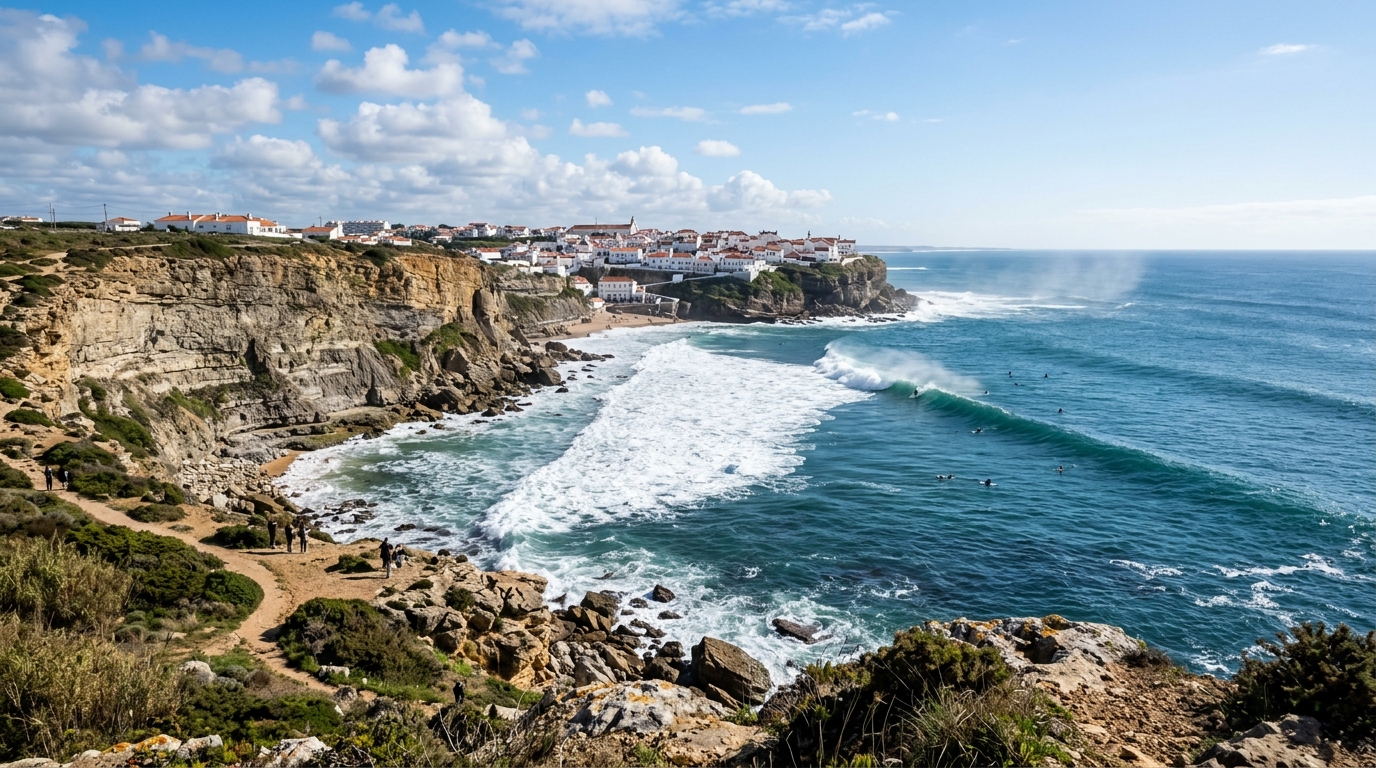
- Top Surf Hubs: Ericeira (Ribeira d'Ilhas right point, heavy barrels at Coxos, mellow waves at Foz do Lizandro); Peniche (Supertubos European pipeline, sheltered longboarding at Baleal Cantinho); Cascais & Caparica (Lisbon metro surf, Carcavelos tubes); Algarve (Sagres dual-coast south/west swell wraps, Arrifana).
- Wave & Ocean Profile: Heavy WNW/NW groundswells peak from October to April (6–15 ft faces). May to September delivers forgiving 2–4 ft summer peelers. Water hovers at 13°C–17°C, requiring a 4/3mm sealed steamer in winter and 3/2mm in summer. The afternoon Nortada trade wind blows onshore by 13:00, making 06:30 dawn patrols essential.
- Accommodation Economics: Surf camp dorms cost $850–$1,200/mo ($250–$380/wk); modern coastal T1 apartments cost $1,300–$1,800/mo off-peak ($2,400–$4,000/mo in summer Airbnb surge); private coastal pool villas cost $2,800–$4,500/mo. Total nomad budget: $2,400 – $3,500 USD/month.
- Visa & Startup Strategy: The D8 Digital Nomad Visa requires 4x national minimum wage (€3,480/month or ~$3,760 USD). The D2 Visa covers founders incorporating a Portuguese Lda. The NHR successor regime (IFICI) grants a flat 20% Personal Income Tax rate for 10 years to founders and tech talent in certified innovative companies. Review our Portugal Expat Guide.
- Remote Work Infrastructure: 92%+ FTTH fiber deployment across coastal villages (500Mbps–1Gbps symmetrical for $35/mo). Hubs: Salt Studio and Kelp Cowork in Ericeira; Baleal Surf & Cowork in Peniche; Second Home Lisboa and LACS Cascais. 35 minutes to Lisbon Airport (LIS).
Spain: Basque Country, Cantabria & Canary Islands
Spain offers an unmatched lifestyle duality: the rich culinary and tech heritage of the North Atlantic coast (Zarautz, Mundaka, Somo) contrasted with the 365-day warm-water volcanic reef slabs of the Canary Islands (Fuerteventura and Tenerife). Supported by the European Union's most progressive Startup Act and Europe's largest fiber network.
- Top Surf Hubs: Basque Country (Zarautz 2.5km sandbar, Mundaka rivermouth left barrel, San Sebastián Zurriola urban break); Cantabria (Somo official Surf Reserve, Suances Los Locos cliff wedges); Canary Islands (Fuerteventura North Shore volcanic slabs at El Hierro and Majanicho, Tenerife Las Américas).
- Wave & Ocean Profile: Basque/Cantabria winter swells (Sep–Apr) produce heavy 6–14 ft pulses with south offshore winds; water requires a 4/3mm fullsuit with 3mm booties (11°C–13°C). The Canary Islands provide year-round 18°C–24°C water, requiring only a 3/2mm fullsuit or springsuit, with powerful northern groundswells from October to March.
- Accommodation Economics: Shared surf hostel beds run $650–$950/mo off-season; town apartments in Zarautz or Somo rent for $900–$1,500/mo; Fuerteventura (Corralejo) apartments cost $850–$1,350/mo. Total monthly nomad budget: $1,800 – $2,800 USD/month.
- Visa & Startup Strategy: Spain's Teletrabajo Digital Nomad Visa (Startup Act Ley 28/2022) requires 200% of minimum wage (€2,646/month or ~$2,900 USD). Qualifying remote founders can invoke the Beckham Law, capping tax at a flat 24% on Spanish-source income up to €600,000 while keeping foreign income 100% tax-exempt for 6 tax years. Certified startups pay a reduced 15% corporate tax rate. Review our Spain Expat Guide.
- Remote Work Infrastructure: Spain leads Europe with 88%+ FTTH fiber coverage (symmetrical 600Mbps–1Gbps standard). Spaces: Spot Coworking (Gros, San Sebastián), Co.Working Corralejo (Fuerteventura), Zen Den (Tenerife). Zarautz connects to San Sebastián in 20 mins; Somo links to Santander via a 20-min scenic ferry.
Indonesia: Bali (Bukit, Canggu, Medewi) & South Lombok
Indonesia remains the world's premier wave laboratory. From the legendary limestone reef barrels of the Bukit Peninsula (Uluwatu, Padang Padang, Bingin) to the digital nomad powerhouse of Canggu and the 600-meter left point break at Medewi, Bali pairs unmatched wave density with a world-class remote tech ecosystem.
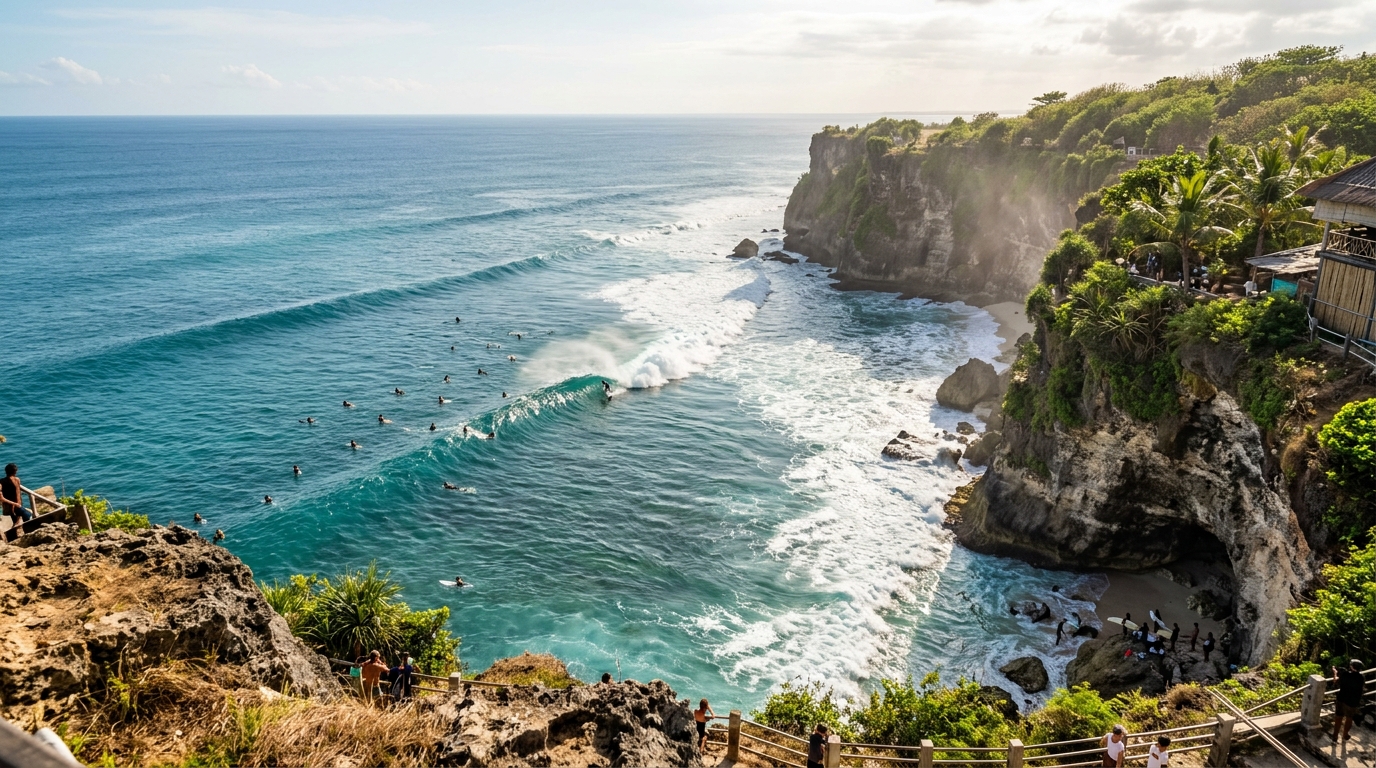
- Top Surf Hubs: The Bukit (Uluwatu Peak/Racetracks, Padang Padang tube, Bingin mechanical left, Balangan); Canggu & Pererenan (Echo Beach sandbar, Batu Bolong longboarding); Medewi (longest left cobblestone point in Bali, 300–600m rides); South Lombok (Gerupuk Bay inside/outside, Mawi A-frame, Desert Point world-class slab).
- Wave & Ocean Profile: Dry Season (May–Oct) delivers relentless Southern Ocean groundswells (14–20s period) with East/SE offshore trade winds grooming the west coast. Wet Season (Nov–Apr) turns East Coast spots offshore (Keramas, Nusa Dua, Sanur). Water stays 27°C–29°C year-round (boardshorts always; 1mm top for July/August upwelling).
- Accommodation Economics: Modern guesthouse / *Kost Eksklusif* runs $350–$650/mo; serviced western studios cost $700–$1,200/mo; 1-bed private pool villas cost $1,200–$2,200/mo. Total monthly budget: $1,200 – $2,400 USD/month. Watch out for private PLN submeter markups (demand *Listrik Pintar* token meter access).
- Visa & Startup Strategy: The E33G Remote Worker Visa (Digital Nomad KITAS) grants 1–2 years of legal residency for foreign remote workers earning $60,000 USD/year. Bootstrappers utilize 60-to-180-day B211A visit visas. Tech companies incorporate a PT PMA (100% foreign-owned, IDR 10B investment plan) with Investor KITAS (E28A/B). Under the Omnibus Law, qualifying foreign tech professionals enjoy a 4-year territorial tax exemption on foreign income. Review our Bali Expat Guide.
- Remote Work Infrastructure: Bwork Bali (Nelayan, Canggu) offers enterprise dual-fiber + automated Starlink backup with quiet floors; Tribal Bali in Pererenan provides custom ergonomic work booths; Tropical Nomad hosts active startup pitch nights. Always verify an on-site automatic-transfer diesel generator (genset).
Philippines: Siargao Island, La Union & Baler
The Philippines combines deep Pacific groundswells with an English-speaking population, low living costs, and one of the world's most generous rolling tourist visa regimes (up to 36 months). Siargao Island is the country’s wave jewel, where the recent deployment of SpaceX Starlink has revolutionized island remote work.
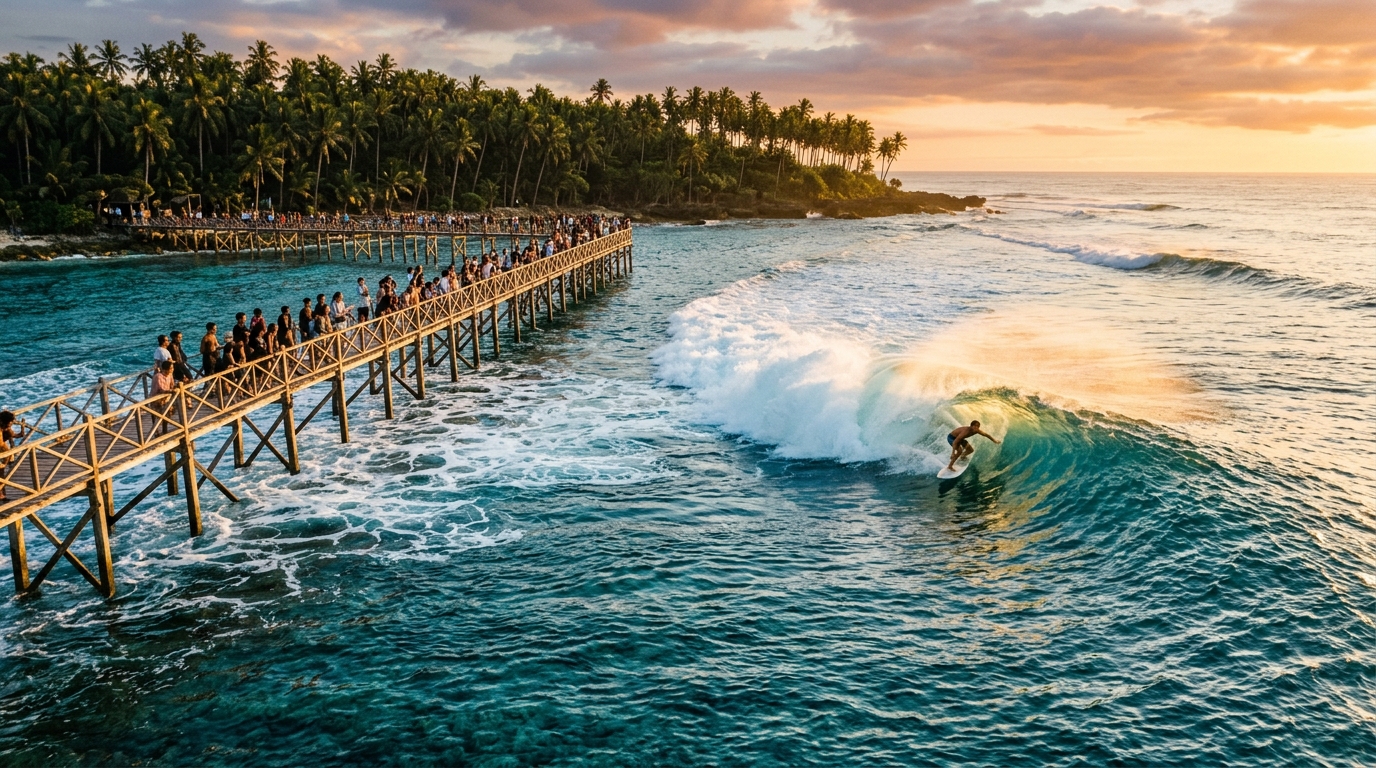
- Top Surf Hubs: Siargao Island (Cloud 9 heavy right reef barrel, Tuason Point left slab, Pacifico left point, Daku Reef boat wave); La Union / San Juan (Monaliza Point cobblestone peeler, Urbiztondo beach break); Baler (Sabang Beach wide sandbars, Charlie's Point rivermouth).
- Wave & Ocean Profile: Siargao peaks August through November with clean Pacific groundswells and offshore SW winds (4–10 ft+). La Union and Baler fire during the Northeast Monsoon (Amihan: Oct–March). Water temperature is 28°C–30°C year-round (0mm neoprene; rashguards and rubber reef booties mandatory for Siargao limestone shelves).
- Accommodation Economics: Surf camp bunks run $300–$480/mo; native bamboo/nipa private villas cost $650–$1,100/mo; modern resort suites with generators rent for $1,400–$2,600/mo. Long-term local leases save 35%–45% vs Airbnb. Total nomad budget: $1,200 – $2,000 USD/month.
- Visa & Startup Strategy: Non-visa-required citizens enter on a 30-day waiver and extend in country via the Bureau of Immigration e-Services portal up to a maximum continuous duration of 36 months before requiring a reset border bounce. The pending Digital Nomad Act (HB 8165) provides a dedicated 24-month framework. Under Section 23 of the NIRC, the Philippines operates a strictly territorial tax system for non-citizens; remote income from foreign clients paid into foreign accounts is untaxed. Review our Philippines Expat Guide.
- Remote Work Infrastructure: Starlink is essential to bypass island subsea cable faults (delivering 120–240Mbps across General Luna). Alter Space and Greenhouse Cafe offer dual Starlink failovers. Due to SIARELCO grid instability, never lease long-term housing without an on-site automatic-transfer diesel generator and mini-UPS for the router. Scooters with surf racks rent for $90–$140/mo.
Thailand: Phuket (Kata, Kalim, Nai Harn) & Khao Lak
Thailand's Andaman coast provides one of the world's most accessible, high-comfort surf and remote-work destinations. When the Southwest Monsoon activates between May and October, Phuket and Phang Nga transform into consistent beach and reef break havens, backed by world-class hospitals, 1Gbps fiber, and the 5-Year DTV Visa.
- Top Surf Hubs: Phuket (Kata Beach sandbars for longboarding and progression, Kalim Reef for steep intermediate-to-advanced right-hand barrels, Nai Harn lagoon rivermouth, Bang Tao); Phang Nga / Khao Lak (Memories Beach at Pakarang Cape—Thailand's most consistent daily wave engine).
- Wave & Ocean Profile: Active during the Southwest Monsoon (May to October). Produces clean 2–5 ft beach break peelers and occasional 6–8 ft groundswell pulses at Kalim Reef. Mellow 6–10s periods suit high-volume shapes, fish boards, and logs. Water is 28°C–30°C (boardshorts only). Mornings (06:00–10:00) offer light offshore winds before afternoon rains.
- Accommodation Economics: The surf season coincides with Phuket's low tourist season, unlocking 30% to 50% rental discounts. Surf camp dorms cost $300–$550/mo; beachfront serviced 1BR condos in Kata/Rawai cost $650–$1,200/mo; private pool villas cost $1,600–$3,200/mo. Total nomad budget: $1,100 – $1,900 USD/month.
- Visa & Startup Strategy: The 5-Year Destination Thailand Visa (DTV) grants 180 days per entry (extendable once for 180 days for 10,000 THB), requiring 500,000 THB (~$14,500 USD) in liquid savings. Surfing academies in Khao Lak qualify under the visa's official "soft power / sports training" quota. Under Revenue Department Order P. 161/2566, tax residents (≥180 days) are taxed on foreign income remitted into Thailand; staying under 180 days during the May–Oct surf season eliminates Thai personal tax exposure entirely. Review our Thailand DTV Visa Guide and Thailand Expat Guide.
- Remote Work Infrastructure: 1Gbps/500Mbps symmetrical fiber is ubiquitous ($15–$25/mo). Coworking spaces: Grind Time Co-Work (Rawai, 24/7 biometric access and backup generators), The Project (Rawai), Garage Society (Phuket Town). Unlimited 5G mobile data costs $15–$25/mo.
Japan: Chiba (Olympic Coast), Shonan & Miyazaki
Japan pairs world-class Pacific wave consistency with hyper-efficient rail infrastructure and modern startup incentives. Founders can surf Olympic A-frame beachbreaks in Chiba at 6:00 AM, board a 60-minute express train, and pitch venture capital firms in Tokyo Station or Shibuya before lunch.
- Top Surf Hubs: Chiba Sotobo Coast (Ichinomiya / Tsurigasaki Shida Point—official 2020 Olympic venue with heavy A-frame peaks, Torami hollow sandbars, Hebara); Shonan / Sagami Bay (Kugenuma-Kaigan longboard mecca, Chigasaki reef, Enoshima rivermouth with views of Mt. Fuji); Miyazaki (Kyushu) (Kisaki-hama ISA contest venue, Aoshima mellow waves, Nichinan cobblestone points).
- Wave & Ocean Profile: Typhoon Season (August to October) generates world-class long-period groundswells (12–18s period, overhead to triple-overhead). Winter low-pressure systems bring relentless clean surf to Chiba with crisp offshore winds. Wetsuits: Chiba winter requires a 5/4mm or 5/3mm semi-dry with boots and gloves (12°C–14°C water); Miyazaki is much milder (3/2mm in spring/autumn, boardshorts in summer).
- Accommodation Economics: Surf hostels run $500–$850/mo; dedicated coastal surf apartments (1LDK with outdoor hot shower and board racks) cost $650–$1,100/mo in Chiba and $900–$1,700/mo in Shonan; traditional timber *Kominka* houses rent for $800–$1,800/mo. Total monthly budget: $1,850 – $2,800 USD/month.
- Visa & Startup Strategy: The Japan Digital Nomad Visa grants up to 6 months for remote workers earning at least ¥10,000,000 gross annual income (~$65,000 USD). For incorporated founders, Startup Visa programs in Fukuoka and Shibuya (Tokyo) waive traditional capital requirements for 6–12 months. Non-Permanent Resident (NPR) status protects foreign investment gains from domestic tax if unremitted. Review our Japan Expat Guide.
- Remote Work Infrastructure: 1Gbps to 10Gbps symmetrical fiber (NURO Hikari, FLET'S Cross) deployed ubiquitously (ping to AWS Tokyo <10ms). The JR *Wakashio* Limited Express connects Kazusa-Ichinomiya directly to Tokyo Station in 60 minutes flat. Miyazaki Airport sits 10 minutes from surf breaks with 10+ daily 95-minute flights to Tokyo Haneda. Hubs: SUZUMINE and Tsurigasaki Surf Hub in Chiba; NEKTON in Shonan; Aoshima Works in Miyazaki.
Taiwan: Taitung (WSL Jinzun, Dulan), Yilan & Kenting
Taiwan is Asia’s hidden high-performance surf frontier. Along Provincial Highway 11 on the rugged East Coast, 3,000-meter Central Range mountains drop directly into the deep Pacific Ocean trench. Boasting 90%+ swell consistency during the Northeast Monsoon, Taiwan combines world-class cobblestone point breaks with the prestigious Taiwan Employment Gold Card open work permit.
- Top Surf Hubs: Taitung County (Jinzun Harbor—annual host of the WSL Taiwan Open of Surfing with hollow lefts and rights; Donghe Rivermouth cobblestone point; Dulan bohemian surf village); Yilan County (Wai'ao black volcanic sand beach break, 50 mins from Taipei); Kenting (Jialeshui 250-meter right point break, Nanwan).
- Wave & Ocean Profile: Northeast Monsoon (October to March) delivers relentless 4–10 ft+ daily surf with 90–95% consistency. Summer and autumn bring clean, powerful Pacific typhoon groundswells (6–15 ft+ faces). Water temperature is 22°C–24°C in winter (2mm top or 3/2mm fullsuit in Taitung/Yilan) and 28°C+ in summer (boardshorts). Note: Maritime law mandates clearing the ocean during formal CWA Typhoon Warnings under threat of fines.
- Accommodation Economics: Surf hostel bunks in Dulan cost $350–$550/mo; local B&B (*Minsu*) private rooms run $650–$1,100/mo; 2–3 bedroom coastal houses rent for $650–$1,000/mo. Total monthly budget: $1,150 – $1,680 USD/month.
- Visa & Startup Strategy: The Taiwan Employment Gold Card is a 4-in-1 open work permit, residency, and multi-entry visa (valid 1–3 years) for tech professionals and founders with verified monthly income ≥ NT$160,000 (~$5,000 USD/mo). Gold Card holders enjoy a 50% income tax deduction on salary over NT$3M for their first 5 years, with foreign income exempt from the Alternative Minimum Tax. Fast-track permanent residency (APRC) in 3 years. Review our Taiwan Expat Guide.
- Remote Work Infrastructure: Chunghwa Telecom FTTH fiber (100–500Mbps) lines Highway 11; 5G mobile coverage reaches directly onto the surf breaks. Dulan Village features an active community centered around the Dulan Sugar Factory art campus. High-speed *Puyuma* express trains connect Taitung to Taipei in 3.5 hours; Yilan is 1 hour by train.
Vietnam: Da Nang (My Khe, Non Nuoc, Son Tra) & Mui Ne
Da Nang offers the ultimate financial runway arbitrage on earth for early-stage software engineers and bootstrapped founders. For under $1,200 USD per month, you can live in a modern beachfront serviced high-rise, surf consistent winter sandbar peaks at My Khe Beach, and build products across an exceptional specialty coffee and coworking ecosystem.
- Top Surf Hubs: Da Nang (My Khe Beach sandbar peaks directly accessible from the An Thuong nomad quarter; Non Nuoc open beach break handling 6–7 ft pulses; Man Thai tucked in the lee of Son Tra mountain, wrapping clean groomed waves during winter gales); Mui Ne (Hon Rom and Suoi Nuoc punchy beach breaks and wind swell).
- Wave & Ocean Profile: Winter Northeast Monsoon swell window runs October through March/April, generating consistent 2–5 ft beach break waves (70–80% rideable days). Flat summer (May–Aug) is ideal for heads-down coding sprints and open-water swimming. Water temperature is 24°C–25°C in winter; a 1.5mm–2mm neoprene top or shorty is recommended for windy 6:00 AM dawn patrols. Zero reef cuts or urchin hazards.
- Accommodation Economics: Modern serviced 1-bedroom apartments (kitchenette, weekly cleaning, 100Mbps fiber) in An Thuong rent for $300 to $480 USD/month; luxury oceanfront high-rises on Vo Nguyen Giap cost $600–$1,100/mo. Total monthly nomad burn rate: $900 – $1,400 USD/month ($25k in savings provides 24 months of full-time building runway).
- Visa & Startup Strategy: 90-day multiple-entry e-visas cost $50 USD. Founders maintain continuous residency through quick overland border runs to Laos (Lao Bao border crossing: $35 transport return) or regional flights to Bangkok/Singapore. Under the 183-day territorial tax rule, non-residents pay tax solely on Vietnam-sourced income; foreign remote earnings paid abroad remain untaxed. Foreign-invested enterprises (FIEs) provide 1–2 year Temporary Residence Cards (TRCs). Review our Vietnam Expat Guide.
- Remote Work Infrastructure: 150–400Mbps fiber is standard ($12–$18/mo). Coworking: Enouvo Space (An Thuong & Son Tra) features ergonomic standing desks, silent meeting booths, and dual-WAN backup; DNC caters to local developer teams. Specialty cafes (43 Factory, The Hideout, Roots) provide 200Mbps Wi-Fi and power outlets at every seat.
Malaysia: Cherating Point, Tioman Island & Desaru Coast
Malaysia's East Coast is Southeast Asia’s premier winter longboarding haven. During the Northeast Monsoon, Cherating lights up with 300-meter sand point peelers wrapping around granite headlands. Coupled with the government's official DE Rantau Digital Nomad Pass and territorial tax framework, Malaysia provides an English-speaking, legally sound sanctuary for digital entrepreneurs.
- Top Surf Hubs: Cherating (Pahang) (Malaysia's surf capital; long, forgiving left-hand sand point break offering 100m–300m rides; host of the Cherating International Surfing Competition); Juara Beach (Tioman Island) (punchier beach break A-frames); Pantai Batu Burok (Terengganu); Tanjung Balau / Desaru Coast (Johor) (closest surf break to Singapore, 1.5 hrs from Woodlands/Tuas).
- Wave & Ocean Profile: The swell window is strictly November to March (Northeast Monsoon), generating continuous 2–5 ft windswells (reaching 6–8 ft on peak storm depressions). The off-season (April–October) is completely flat lake-like water, during which nomads relocate to KL/Penang or regional island hubs. Water is 28°C–30°C (boardshorts always). Dawn patrol (06:30–09:30 AM) captures glassy conditions before onshore monsoon winds build.
- Accommodation Economics: Beach chalets at Cherating cost $28–$55/night ($550–$900/mo); surf camp rooms cost $250–$420/mo; upscale coastal resorts cost $1,800–$3,500/mo. Local dining (Nasi Lemak, Ikan Bakar) costs $1.50–$3.50/meal. Total monthly nomad budget: $900 – $1,500 USD/month.
- Visa & Startup Strategy: The DE Rantau Digital Nomad Pass (MDEC) grants 12 to 24 months of legal residency for tech professionals and founders with an annual foreign income of $24,000 USD ($2,000/mo). Under Section 3 of the Income Tax Act 1967, Malaysia operates a territorial tax system; foreign-sourced remote income brought into Malaysia is officially tax-exempt through 2026. Review our Malaysia Expat Guide.
- Remote Work Infrastructure: National 5G Single Wholesale Network (DNB) covers Cherating, Kuantan, and Desaru with 150–450Mbps mobile throughput (unlimited plans cost $8–$14/mo). Cherating connects to Kuala Lumpur in 3.0 to 3.5 hours via the East Coast Expressway (LPT1); Tanjung Balau connects to Singapore in 1.5 to 2.0 hours. English is the universal business and legal language.
South Korea: Yangyang (Surfyy Beach), Jeju & Busan
South Korea has engineered one of the world's most hyper-modern coastal workation scenes. Yangyang County in Gangwon Province has evolved into Korea’s dedicated surfing capital, combining pristine East Sea groundswells, vibrant creator beach cafes, 10Gbps fiber, and rapid 2-hour expressway transit to Seoul’s venture ecosystem.
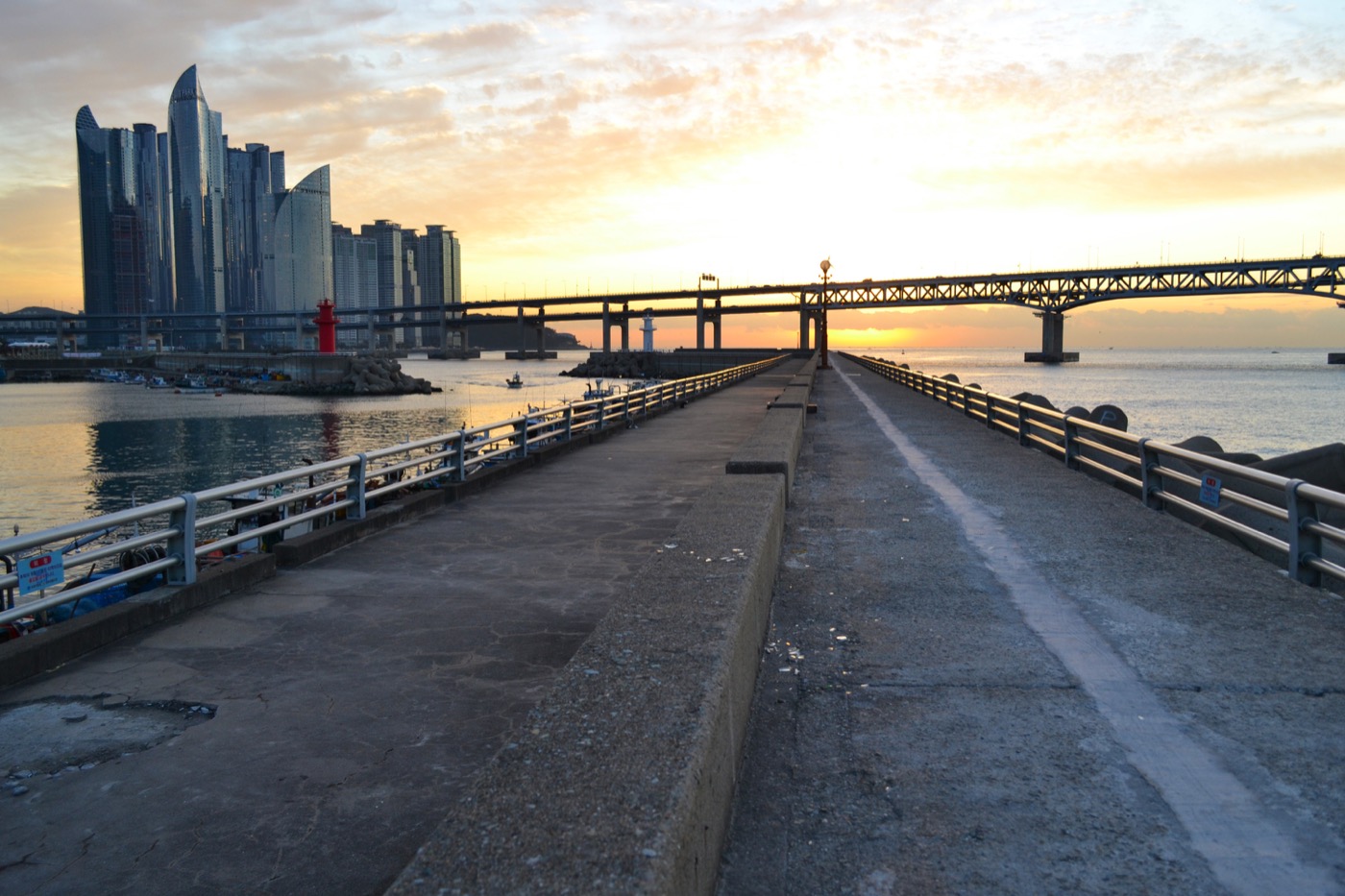
- Top Surf Hubs: Yangyang (Jukdo Beach longboarding bay; Ingu Beach cultural heart with 50+ surf taprooms and creator cafes; Surfyy Beach designated surfing-only beach); Jeju Island (Jungmun Saekdal Beach subtropical volcanic reef); Busan (Songjeong Beach urban sandbars, 20 mins from Centum City tech district).
- Wave & Ocean Profile: Yangyang peaks in Autumn and Winter (Sep–March) with clean North/NE groundswells groomed by Siberian offshore winds (4–8 ft+ hollow walls). Jeju and Busan fire during Summer typhoon pulses (Jul–Oct). Yangyang winters require a 5/4/3mm hooded winter steamer with 5mm booties and lobster mitts (water 5°C–10°C; air sub-zero); autumn offers a golden window of 18°C water and mild 20°C air.
- Accommodation Economics: Surf academy capsule dorms cost $420–$750/mo ($18–$35/night); modern studio pensions (*Minbak* with *Ondol* underfloor heating) rent for $750–$1,350/mo; boutique beachfront lofts cost $1,500–$2,600/mo. Total monthly nomad budget: $1,600 – $2,600 USD/month.
- Visa & Startup Strategy: The F-1-D Workation Visa grants up to 2 years for remote workers earning at least twice Korea's GNI per capita (~$64,000 – $66,000 USD/year). For tech entrepreneurs, the OASIS Points-Based Startup Visa (D-8-4) fast-tracks residency. The K-Startup Grand Challenge (KSGC) provides $12,000 USD living stipends, free labs at Pangyo Techno Valley, and follow-on settlement grants up to $60,000 USD. Review our South Korea Expat Guide.
- Remote Work Infrastructure: 95%+ nationwide 5G coverage (median download 400–850Mbps) with 1Gbps to 10Gbps fiber standard in coastal cafes. Express buses reach Seoul Station or Gangnam in 1 hr 50 mins via the Seoul-Yangyang Expressway; KTX bullet trains reach Busan in 2 hrs 15 mins. Municipal subsidized workation centers provide free dual-monitor hot desks to remote workers.
UAE: Surf Abu Dhabi (Kelly Slater Wave Co) & Dubai
The UAE has established an unprecedented lifestyle and financial arbitrage for surfing founders: the world’s largest, longest, and most advanced artificial barreling wave at **Surf Abu Dhabi**, combined with a **0% personal income tax** and **0% capital gains tax** corporate ecosystem within an 8-hour flight of two-thirds of the globe.
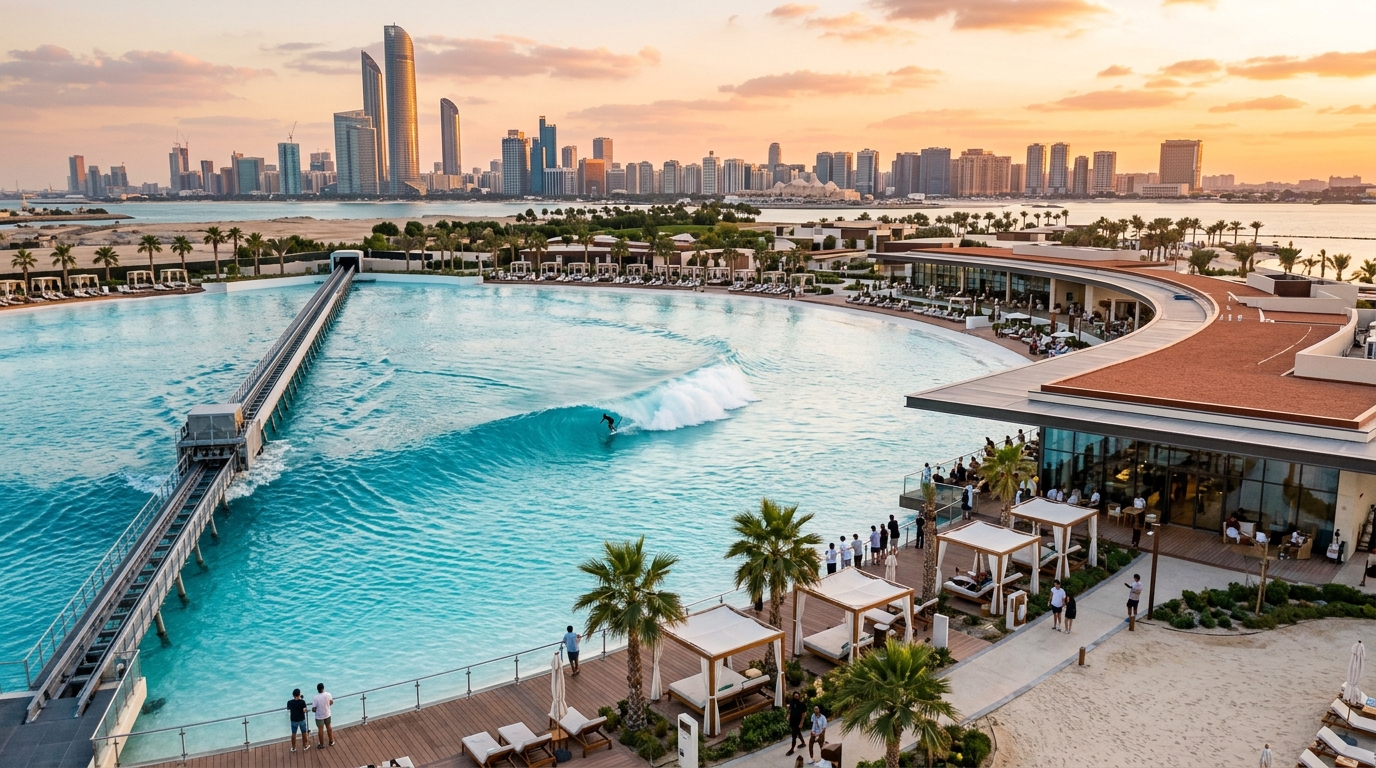
- Top Surf Hubs: Surf Abu Dhabi (Hudayriyat Island) (KSWC technology; world’s longest man-made wave ride at 35–45+ seconds; world's highest artificial barrel reaching 6–7ft+ pro faces; floodlit night surfing; host of WSL Championship Tour stops); Sunset Beach / Umm Suqeim (Dubai) (natural winter windswells against the Burj Al Arab, anchored by Surf House Dubai); Al Khan Beach (Sharjah).
- Wave & Ocean Profile: Surf Abu Dhabi operates 100% mechanical consistency year-round with automated temperature chiller regulation during summer heat. Natural ocean windswells roll into Dubai from December to March during *Shamal* winter cold fronts (2–5 ft beach breaks). Winter water is 21°C–24°C (2mm springsuit); summer water is 32°C+ (boardshorts only).
- Accommodation Economics: Luxury serviced 1BR apartments in Dubai Marina / JBR cost $3,200–$5,200/mo; modern apartments on Yas Island (20 mins to Surf Abu Dhabi) rent for $1,600–$2,600/mo; Rove Hotel digital nomad packages cost $1,800–$2,700/mo. Single wave sessions at Surf Abu Dhabi cost $165–$260 USD (improver) or $410–$870 USD (barrel mode). Total monthly operating cost: $4,500 – $10,000+ USD/month.
- Visa & Startup Strategy: The Dubai Virtual Working Programme is a 1-year renewable remote work visa requiring **$3,500 USD/month** income. Founders establishing corporate entities utilize **10-Year Golden Visas** or Free Zone companies (IFZA, DMCC, Hub71/ADGM). Personal income tax is **0%**, capital gains tax is **0%**, and qualifying Free Zone corporate profits are taxed at **0%**. Review our Dubai Expat Guide and Zero-Tax Countries Guide.
- Remote Work Infrastructure: Ranked #1 globally for mobile broadband speeds (5G speeds exceed 350–550Mbps). Symmetrical gigabit fiber is standard ($110–$180/mo). Premier spaces: WeWork One Central, Bureau (Gold & Diamond Park), A4 Space (Alserkal Avenue), and Hub71 on Al Maryah Island. Dubai and Abu Dhabi airports offer non-stop flights to over 250 global cities.
Singapore: Trifecta Citywave & The Regional Strike Corridor
While Singapore lacks open-ocean surf beaches, it functions as the ultimate super-commuter launchpad and corporate headquarters for maritime and tech founders. Founders can carve authentic deep-water standing waves at **Trifecta on Orchard Road** over lunch, ride a 90-minute ferry to Desaru's winter sandbars, or catch a 2.5-hour direct flight to Bali's reef breaks for 48-hour weekend strike missions.
- Top Surf Hubs & Access Routes: Trifecta Singapore (Somerset / Orchard Rd) (German Citywave deep-water standing wave pool allowing real PU/epoxy shortboards with thruster fins; adjustable 0.9m–1.5m barreling faces; 10 mins from the CBD); Desaru Coast (Malaysia) (90-minute direct fast ferry from Tanah Merah Ferry Terminal or 2-hour private drive, delivering 3–6 ft winter monsoon surf); Turnkey Weekend Indo Strikes (2.5-hour direct flights from Changi to Bali; seaplane and ferry corridors to Mentawai Islands and Nias).
- Wave & Ocean Profile: Trifecta operates 365 days a year indoors with infinite wave consistency. Desaru fires from November to March (NE Monsoon). Mentawais and Bali peak with Southern Ocean groundswells from April to October. Equatorial temperature hovers at 30°C–32°C year-round (boardshorts always).
- Accommodation Economics: Luxury coastal condominiums in the East Coast Park corridor (Meyer/Amber Rd, 10 mins to Changi) rent for $4,200–$7,200/mo; premium shophouse co-living suites (Habyt, Cove) cost $2,400–$4,200/mo; Sentosa Cove marina condos cost $6,500–$11,500/mo. Total monthly budget: $4,500 – $9,000+ USD/month.
- Visa & Startup Strategy: Top founders utilize the ONE Pass (Overseas Networks & Expertise Pass) (5-year personalized visa, min. SGD 30,000/mo), Tech.Pass, or EntrePass. Singapore operates a **territorial tax system**, **0% capital gains tax**, **0% dividend tax**, and flat 17% corporate tax with Start-Up Tax Exemptions (SUTE: 4.25% effective rate on initial income). Maritime and deep-tech founders access non-dilutive grants up to SGD 100k–500k via PIER71 and MPA. Review our Singapore Expat Guide.
- Remote Work Infrastructure: 10Gbps symmetrical residential fiber standard (IMDA digital blueprint, $50–$65 USD/mo; sub-1ms domestic latency). Changi Airport’s automated biometric gates allow curbside-to-gate transit in <15 minutes. Coworking spaces: The Great Room, BLOCK71, and JustCo.
Frequently Asked Questions
Can digital nomads legally work remotely while staying on tourist visas in global surf destinations?
While millions of digital nomads historically worked on tourist visas in a legal grey area, performing remote work on tourist status violates domestic labor laws in most countries. In 2026, leading surf nations offer dedicated statutory digital nomad pathways: Thailand offers the 5-Year Destination Thailand Visa (DTV) requiring 500,000 THB in liquid savings; Spain provides the Teletrabajo Digital Nomad Visa under the Startup Act; Portugal offers the D8 Digital Nomad Visa (requiring 4x national minimum wage); Malaysia operates the DE Rantau Pass; and Indonesia provides the E33G Remote Worker KITAS. Utilizing official remote worker visas ensures legal banking access, local lease registration, and immunity from immigration blacklisting.
What is the best legal and tax strategy for a surfing entrepreneur spending 3 to 6 months per country?
The cleanest legal and tax strategy for nomadic surfing founders is the Sub-180-Day Perpetual Non-Residency Architecture: by capping your stay in any single sovereign nation below its domestic statutory tax residency threshold (180 days in Thailand, 183 days in Indonesia, Spain, Portugal, and Taiwan), you avoid becoming a local tax resident subject to progressive worldwide income taxation. You structure your operating company in an offshore corporate hub (e.g., Delaware LLC, UK Ltd, or Singapore private company), maintain personal tax residency in a territorial or zero-tax jurisdiction, and finance coastal living expenses through multi-currency debit accounts like Wise or Revolut.
How do I protect laptops, cameras, and electronics from salt air corrosion and tropical humidity?
Coastal air within 1 kilometer of breaking surf carries microscopic airborne sodium chloride particles that oxidize logic boards and corrode USB ports. Essential hardware defenses include: 1) Storing all computing equipment inside an airtight, IP67-rated Pelican Air 1535 case containing two 50g color-indicating regenerating silica gel canisters; 2) Inserting silicone dust plugs into all unused USB-C, HDMI, and headphone ports; 3) Wiping laptop keyboards, chassis, and screens daily with 70% anhydrous isopropyl alcohol wipes; and 4) Never operating fan-cooled laptops directly on sandy beaches or in unconditioned rooms with relative humidity exceeding 75%.
What are the airline baggage fees and policies for flying with surfboard bags across Asia and Europe?
Surfing airline baggage policies vary significantly: Surf-friendly legacy carriers like Singapore Airlines, Qatar Airways, Emirates, and Japan Airlines (JAL) allow surfboard travel bags (up to 200–300 cm in length and 23–32 kg) as part of your standard complimentary checked baggage allowance. In contrast, European low-cost carriers (Ryanair, EasyJet) and Asian budget carriers (AirAsia, Cebu Pacific, VietJet) mandate specialized sports equipment fees ranging from $45 to $90 USD per flight segment, with strict maximum length limits (often 190–277 cm). Always pre-book sports baggage online at least 48 hours prior to departure, pack nose and tail foam blocks, and use pipe insulation along board rails.
Which global surf hub offers the lowest cost of living with dependable fiber internet for bootstrapping founders?
Da Nang (Vietnam) and Taitung (Taiwan) offer the world's most compelling cost-to-performance ratio for early-stage bootstrapping founders. In Da Nang (My Khe Beach), a solo entrepreneur can live comfortably on $900 to $1,400 USD per month, securing an ocean-view serviced high-rise apartment with 200Mbps symmetric fiber for $350–$550/month, daily local dining for $1.50–$3.00/meal, and 24/7 coworking at Enouvo Space for $95/month. Taitung (Dulan Village, Taiwan) offers world-class cobblestone point breaks, 300Mbps Chunghwa Telecom fiber, and an all-inclusive monthly burn of $1,150 to $1,680 USD under the Taiwan Employment Gold Card.
Verified Primary Sources & Official References
This playbook synthesizes regulatory filings, immigration statutes, oceanographic bathymetry, and telecommunications data from official government and sports bodies:
- Portugal AIMA & Ministry of Foreign Affairs (D8 Visa)
- Spain Ministry of Inclusion, Social Security & Migration (Ley 28/2022)
- Indonesia Directorate General of Immigration (E33G KITAS)
- Thailand Ministry of Foreign Affairs & Tourism Authority (DTV Visa)
- Taiwan National Development Council (Employment Gold Card)
- Malaysia Digital Economy Corporation (MDEC DE Rantau)
- Japan Immigration Services Agency (Specified Activities DNV)
- South Korea Ministry of Justice (F-1-D Workation Visa)
- Dubai Department of Economy and Tourism (Virtual Working)
- Singapore Ministry of Manpower (ONE Pass & Tech.Pass)
- World Surf League (WSL Event Rules & Bathymetry Records)
- Save The Waves Coalition (World Surfing Reserves - Ericeira)
- National Oceanic and Atmospheric Administration (NOAA Ocean Data)
- SpaceX Starlink Satellite Telecommunications Specifications
- International Surfing Association (ISA Safety Standards)
Explore Related Strategic Guides & Sovereign Tools
Complement this surfing lifestyle guide with our tactical engineering playbooks and Mac native tools: