The Vietnam Digital Nomad & Expat Guide: 90-Day e-Visa, Border Runs & Living Costs

On this page
Vietnam is one of the world's most popular and exciting destinations for remote workers, tech bootstrappers, and online entrepreneurs. Offering high-speed fiber internet, incredible street cuisine, low monthly burn rates, and a welcoming culture, it lets you live comfortably for under $1,200 a month. But navigating visas and staying legal requires a clear plan. Here is your comprehensive, plain-English roadmap to living and working in Vietnam.

Comparing this destination against other global nomad and expat visas?
⚡ Vietnam Living & Visas at a Glance
- The 90-Day e-Visa: Available to all nationalities online. Apply through the official immigration portal; the government fee is USD 25 for single entry or USD 50 for multiple entry. Check the application requirements and the validity dates granted on your visa.
- No In-Country Extensions: You cannot extend a tourist e-Visa inside Vietnam. To stay longer than 90 days, you must do a quick "border run" to a neighboring country (Cambodia, Laos, Thailand) and re-enter on a fresh 90-day e-Visa.
- Long-Term Alternative (ĐT3 Investor Visa): If you invest at least 3 Billion VND (~$120,000 USD) to establish a 100% foreign-owned company, you qualify for a 3-year Temporary Residence Card (TRC), eliminating visa runs entirely.
- Mandatory SIM Registration: Under government regulations, all physical SIM cards must be registered in person with your passport at an official corporate branch of Viettel or Vinaphone to prevent your phone from being disconnected after 30 days.
- Housing and dining: Compare current furnished-apartment listings in Da Nang and check whether rent includes utilities. Dining costs depend on the restaurant and neighborhood; build your monthly budget from current local prices.
1. The 90-Day Multiple-Entry e-Visa Explained
Under Vietnam's immigration laws (Law No. 23/2023/QH15), citizens of all countries can apply online for an electronic visa (e-Visa) valid for up to 90 days.
There are two types:
- Single-Entry e-Visa (USD 25): Permits one entry during the visa's stated validity period. After leaving Vietnam, you cannot use that single-entry visa to enter again.
- Multiple-Entry e-Visa (USD 50): Permits repeated entry and exit during the visa's stated validity period. Choose it if your itinerary includes leaving and returning within that period.
⚠️ Beware of Scam Visa Websites
Apply through the official Vietnam e-visa portal. Check the domain carefully before submitting your passport details or paying. If you use an intermediary, ask for an itemized quote separating its service charge from the government visa fee.
2. Step-by-Step Action Plan: How to Apply & What to Do Meanwhile
Here is your step-by-step roadmap from submitting your e-Visa to setting up your new life in Da Nang or Ho Chi Minh City:
Phase 1: File Online on the Official Portal
Day 1Visit evisa.gov.vn and select "For Foreign Individuals".
- Upload a clear photo of your passport bio-page and a straight-on portrait photo without glasses.
- CRITICAL RULE ON YOUR NAME: Enter your full legal name EXACTLY as printed in the 2-line Machine Readable Zone (MRZ) at the bottom of your passport. If your passport says "SMITH, JOHN MICHAEL", enter First Name: JOHN MICHAEL, Last Name: SMITH. Omitting your middle name is the #1 reason airlines deny boarding!
- Select your entry checkpoint (e.g., Tan Son Nhat Airport in HCMC, Noi Bai in Hanoi, or Da Nang Airport).
- Pay the government fee shown in the application: USD 25 for single entry or USD 50 for multiple entry. Check the payment instructions and refund conditions before paying.
Phase 2: Processing & What to Do Meanwhile
Wait Time: 3 to 5 Business DaysImmigration officers process the application within 3 to 5 working days (excluding weekends and Vietnamese national holidays). Always apply 10 to 14 days before your flight to account for potential public holidays.
- Download the Grab app: Grab is the essential superapp for getting taxis, scooter rides, and food delivery across Vietnam. Bind your credit card before arriving.
- Order a multi-currency card: Get a Wise or Revolut card so you can withdraw Vietnamese Dong (VND) at VPBank, TPBank, or MB Bank ATMs without paying exorbitant foreign transaction fees.
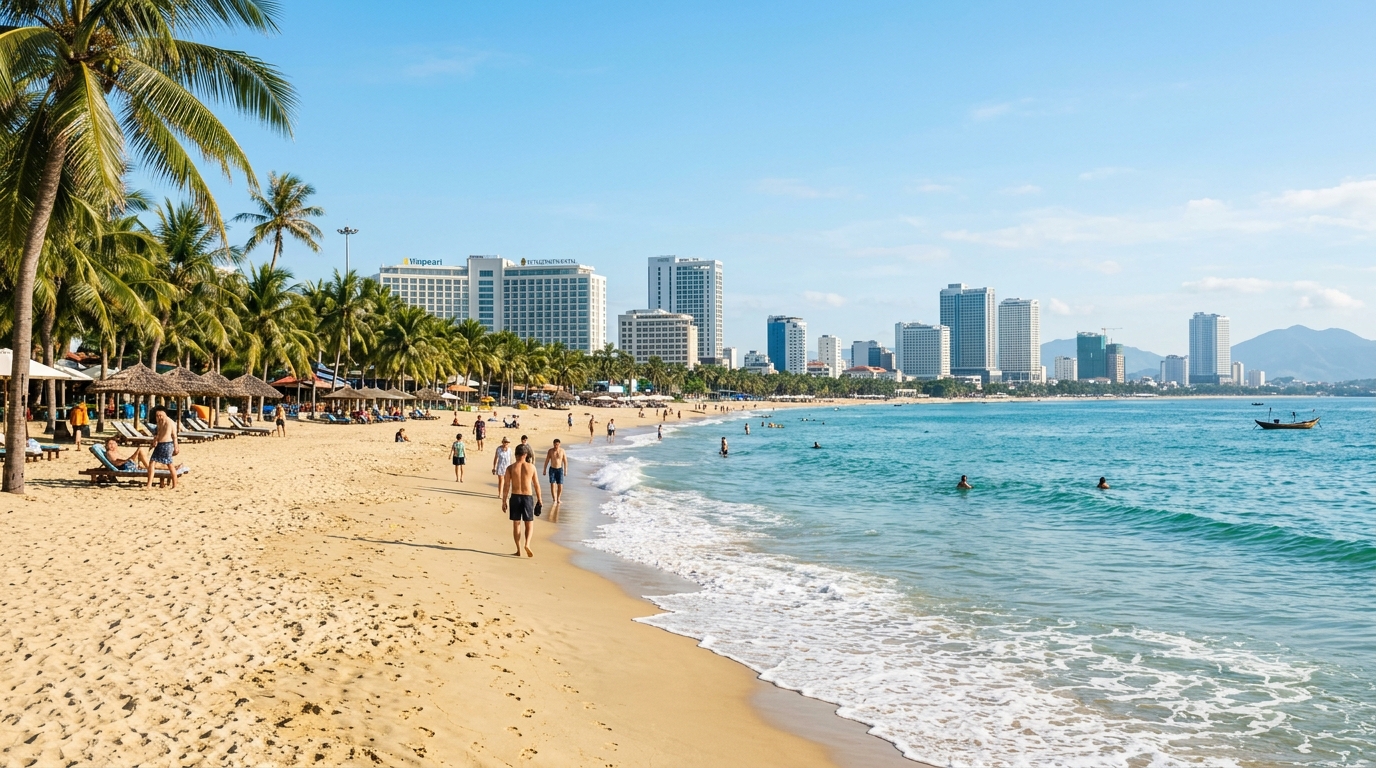
- Research base neighborhoods: In Da Nang, look at My An (An Thuong) for beachside nomad cafes and coworking. In Ho Chi Minh City, look at Thao Dien (District 2) for Western amenities and international dining, or District 1/3 for central city energy.
- Check your passport: Ensure it has at least 6 months of validity beyond your planned departure date and at least two completely blank pages.
Phase 3: Arrival & Airport Immigration Protocol
Arrival DayPrint out two physical color copies of your approved e-Visa PDF document before boarding.
- Walk directly to the regular Passport Control lanes. (You do NOT need to wait at the "Visa on Arrival" counter—that is only for old paper approval letters).
- Present your original passport and your printed e-Visa paper. The officer will stamp your passport with a 90-day stay date.
- Double-check your stamp date immediately: Before walking away from the counter, look at the stamped date in your passport and verify that it matches the 90-day validity on your e-Visa. Correct any clerical errors on the spot.
Phase 4: First 30 Days: SIM Registration & Police Stay Check
First MonthSetting up local utilities and legal registration prevents unexpected headaches:
- Mandatory In-Person SIM Registration: Avoid roadside convenience stall SIM cards. Walk into an official corporate store of Viettel or Vinaphone with your original physical passport. Staff will scan your passport photo and link your identity to your phone number under government telecom decrees. Unlimited monthly 4G/5G data packages cost roughly 150,000 to 250,000 VND (~$6 to $10 USD). Alternatively, configure a travel eSIM (Airalo / Nomad) prior to departure so you have instant mobile data to hail a Grab ride from SGN or HAN airport.
- Police Temporary Residence Registration: Vietnamese law requires all foreign visitors to be registered with the local ward police within 24 hours of moving into an apartment. Your hotel, Airbnb host, or landlord handles this online via the provincial immigration portal. Always ask your landlord: "Have you registered my temporary residence online? Please send me a screenshot of the confirmation."
3. The Visa Run Reality: How to Extend Your Stay
Because in-country extensions for tourist visas do not exist, expats who fall in love with Vietnam and want to stay for 6 months, a year, or longer perform visa runs every 90 days.
Here is how to do it smoothly and legally:
Option A: Land Border Runs (Budget Friendly)
- From Ho Chi Minh City to Moc Bai (Cambodia): Before arranging transport to Moc Bai/Bavet, confirm that the crossing is operating, that you qualify to enter Cambodia, and that your chosen Cambodian visa method is accepted there. Check the official Cambodian visa fee for that method and have an approved Vietnamese visa valid for your intended return. Border processing and admission decisions can affect the timing of the trip.
- From Da Nang to Lao Bao (Laos): Take a morning bus or private car to the Lao Bao border crossing with Laos (~4 to 5 hours). Stamp out of Vietnam, complete Laos visa procedures, stamp out of Laos, and re-enter Vietnam on your new e-Visa.
Option B: Flight Visa Runs (Comfortable & Relaxed)
- Fly from Da Nang, Hanoi, or Saigon to Bangkok (BKK/DMK) or Kuala Lumpur (KUL) on AirAsia, VietJet, or Scoot.
- Spend 2 to 3 days enjoying shopping, coworking, and street food.
- Apply for your new Vietnam e-Visa 10 days before your flight, receive the approval PDF, print it out, and fly back into Vietnam with a fresh 90-day stamp.
Estimate your severance allowance with service exclusions, statutory rounding and official legal sources.
Open the Vietnam Severance Calculator → 베트남 퇴직금 계산기4. The Permanent Alternative: The ĐT3 Investor Visa & TRC
If you run an established online business, SaaS company, or consulting agency and want to avoid visa runs entirely, you can establish a 100% Foreign-Owned Enterprise (FOE) in Vietnam.
🏢 How the ĐT3 Investor Visa Works
Under Vietnamese immigration law, foreign investors who contribute at least 3 Billion VND (~$120,000 USD) in chartered capital to an active Vietnamese company qualify for the ĐT3 Investor Visa.
• Zero Visa Runs: You can enter and exit Vietnam freely as a recognized legal resident.
• Full Local Banking: Open corporate and personal bank accounts with VPBank, Techcombank, or HSBC Vietnam with full international wire transfer privileges.
• Family Sponsorship: Sponsor your spouse and dependent children for accompanying TT residence cards.
5. Monthly Living Budget: Da Nang vs. Saigon vs. Hanoi
Vietnam offers some of the highest purchasing power in the world. Here is what a comfortable expat lifestyle costs per month:
| Expense Category | Da Nang (My An / Beachside 1BR) | Ho Chi Minh City (Thao Dien / D2 1BR) | Hanoi (Tay Ho / West Lake 1BR) |
|---|---|---|---|
| Furnished 1BR Modern Apartment | 12,000,000 VND (~$480 USD) | 18,000,000 VND (~$720 USD) | 15,000,000 VND (~$600 USD) |
| Dining Out & Cafes | 7,500,000 VND (~$300 USD) | 10,000,000 VND (~$400 USD) | 8,500,000 VND (~$340 USD) |
| Electricity (AC), Water & 300Mbps Fiber | 2,000,000 VND (~$80 USD) | 2,500,000 VND (~$100 USD) | 2,200,000 VND (~$88 USD) |
| Unlimited 4G/5G Data Plan | 200,000 VND (~$8 USD) | 200,000 VND (~$8 USD) | 200,000 VND (~$8 USD) |
| Transport (Scooter Rental / Grab) | 1,800,000 VND (~$72 USD) | 2,500,000 VND (~$100 USD) | 2,000,000 VND (~$80 USD) |
| Coworking Space (Enouvo / The Hive) | 2,200,000 VND (~$88 USD) | 3,200,000 VND (~$128 USD) | 2,800,000 VND (~$112 USD) |
| ESTIMATED TOTAL / MONTH | 25,700,000 VND (~$1,028 USD) | 36,400,000 VND (~$1,456 USD) | 30,700,000 VND (~$1,228 USD) |
Frequently Asked Questions (FAQ)
How long can digital nomads stay in Vietnam on the 90-day electronic visa (e-Visa)?
Foreigners from all countries can apply online for a 90-day multiple-entry electronic visa (e-Visa) via the official Vietnam Immigration portal for $25 (single) or $50 (multiple entry). While Vietnam does not offer a dedicated digital nomad visa, remote workers commonly utilize the 90-day e-Visa to reside in Da Nang, Hanoi, or Ho Chi Minh City while performing remote services exclusively for clients abroad.
Can you do consecutive visa runs in Vietnam without getting denied entry?
Yes, consecutive visa runs remain common and operationally viable in Vietnam. Remote workers either take short round-trip flights to Bangkok, Kuala Lumpur, or Singapore, or cross the land borders into Laos (Lao Bao) or Cambodia (Moc Bai). However, Vietnam Immigration officers at Tan Son Nhat (SGN) and Noi Bai (HAN) airports have increased scrutiny on travelers who do back-to-back border runs with same-day returns. Always allow at least 24 to 48 hours outside the country and carry proof of sufficient funds and an outbound ticket.
Can foreigners buy apartments or property in Vietnam?
Foreigners entering Vietnam on a valid visa can legally purchase condominium apartments under the Law on Housing (Law No. 65/2014/QH13), subject to a 50-year leasehold ownership certificate (Pink Book), extendable for another 50 years. However, foreigners cannot own land, and buildings are capped at a 30% foreign ownership quota per condominium development. Furthermore, secondary resales can only be transferred to other foreign buyers unless sold back to a Vietnamese citizen.
When does a foreigner become a tax resident in Vietnam and what are the rates?
Under Vietnamese tax law (Circular 111/2013/TT-BTC), an individual becomes a tax resident if they reside in Vietnam for 183 days or more in a calendar year, or across 12 consecutive months from their first arrival date. Tax residents are subject to progressive personal income tax rates ranging from 5% to 35% on worldwide income. Non-residents (staying under 183 days) are taxed at a flat 20% rate strictly on Vietnam-sourced income. Structuring tax non-residency and managing multi-currency cards is covered in our Expat Banking Playbook and Zero-Tax Countries Guide.
What is the realistic monthly cost of living in Da Nang vs Ho Chi Minh City?
Da Nang is one of the most affordable coastal nomad hubs in the world: a modern sea-view studio apartment in My An or An Thuong rents for $300 to $500 USD per month, and total monthly living costs range from $800 to $1,400 USD. In Ho Chi Minh City (Saigon District 1, 2, or Binh Thanh), modern 1-bedroom serviced apartments rent for $500 to $900 USD, bringing total monthly expenses to $1,300 to $2,000 USD. Domestic fiber internet (Viettel/FPT) is exceptionally fast and costs under $12 USD/month. See our Southeast Asia Cost of Living Showdown.
🛡️ Verified Primary Sources & Official Repositories
🇻🇳 Official Vietnamese AuthoritiesAll e-Visa procedures, immigration laws, temporary stay rules, and investor thresholds are verified against official Vietnamese government repositories:
The sole official government website for 90-day single and multiple-entry e-Visa applications, status tracking, and fee payments.
Visit Official e-Visa Portal ↗Statutory governing body overseeing Law No. 23/2023/QH15 entry/exit regulations, foreign resident registration, and checkpoint enforcement.
Visit Ministry of Public Security ↗Statutory tax authority regulating the 183-day personal tax residency rules and corporate tax requirements for foreign-invested enterprises.
Visit General Dept of Taxation ↗Glossary & Terminology Index
An electronic entry visa issued online by the Vietnam Immigration Department, allowing stays of up to 90 days with single or multiple-entry privileges.
A long-term multi-year identity card and resident visa issued to foreign investors (ĐT visas) or work permit holders, exempting them from visa renewals and border runs.
A 3-year resident investor visa granted to foreigners who invest between 3 Billion and 50 Billion VND (~$120,000 to $2,000,000 USD) in a registered Vietnamese enterprise.
The two lines of letters, numbers, and chevrons (<<<) at the bottom of your passport photo page. Your name on the Vietnam e-Visa must match this line exactly.
🔗 Related Destination & Strategy Playbooks
Explore interconnected legal, healthcare, and tax frameworks across our global network:
Expat Banking & Money Stack
Multi-currency cards (Wise, Revolut, Schwab) and avoiding 5%-12% ATM conversion markups.
Best Travel eSIM Comparison
Airalo vs Nomad vs Viettel local SIM: Southeast Asia data rates and Dual-SIM setup.
Thailand DTV Visa Guide
5-year multiple-entry Destination Thailand Visa with 500,000 THB liquid proof.
Malaysia DE Rantau Nomad Pass
2-year nomad pass, 0% tax on foreign salary, and luxury living in KL and Penang.
Philippines 36-Month Stay
Continuous tourist extensions without border runs and 0% foreign income tax.
Expat Healthcare & Insurance
Avoiding inpatriate policy traps, provincial lapses, and direct-billing hospital tips.