How to Switch Expat Health Plans Without Coverage Gaps
To switch expat health plans without losing pre-existing condition protection or residency visa compliance, secure written underwriting acceptance—via Continued Personal Medical Exclusions (CPME), Continued Moratorium (CMORI), or a Group-Leaver Continuation track—and bind your replacement policy with a 24-to-48-hour overlap before sending written cancellation to your current carrier. If you manage an active chronic condition or ongoing diagnostics, restructuring your existing plan's annual deductible or Area of Cover (such as excluding the United States) normally cuts renewal costs without triggering fresh medical underwriting.
Rule #1: Never Cancel Policy A to "Shop Around"—Even After a Steep Renewal Hike
Switching an international health plan is not like changing a mobile phone carrier. Medical underwriting continuity is a one-way door: once an active policy lapses by even 24 hours—or once you miss a 30-to-90-day non-renewal cutoff—two outcomes hit simultaneously:
- Pre-Existing Condition Re-Lock: Conditions that appeared while insured under Policy A turn into newly excluded pre-existing history under Full Medical Underwriting (FMU), or reset a Moratorium's 24-month clean-period clock back to Day 0.
- Visa & Statutory Compliance Breaks: Consulates and immigration portals (such as Spain's UGE-CE or Thailand's OIC-linked visa renewals) verify unbroken, compliant certificates; any uncovered gap or unrecognized deductible invalidates renewal filings.
Table of Contents — Switch Expat Health Plan Guide
1. Should You Switch Expat Health Plans—or Optimize Your Current Policy?
Before requesting quotes from a competing carrier, run a Stay-and-Restructure check on your existing policy: modifying benefit levers with your current insurer normally preserves all prior medical underwriting, whereas switching carriers forces either strict like-for-like CPME matching or fresh underwriting scrutiny.
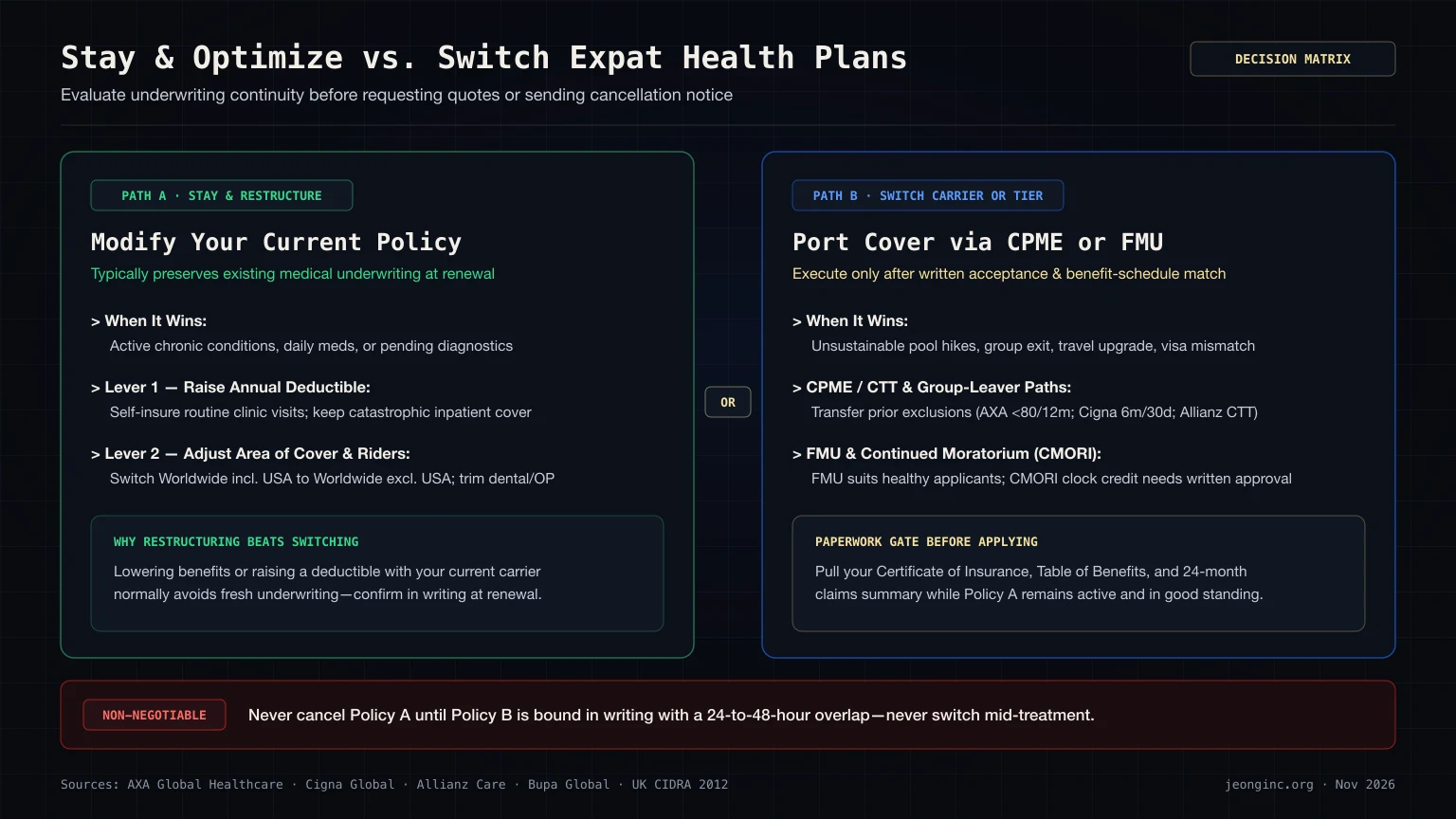
Many expats assume a steep annual renewal quote leaves only two options: pay the full increase or abandon the insurer. In practice, International Private Medical Insurance (IPMI) pricing is driven by three modular settings you can usually adjust at renewal without re-submitting your medical history (always verify in writing with your insurer that a downgrade requires zero re-underwriting).
Raise Annual Aggregate Deductible
Shifting from a zero-deductible plan to a higher annual deductible turns routine clinic visits into predictable out-of-pocket expenses while preserving catastrophic inpatient hospitalization and oncology protection.
Pair with a liquid cash reserve in multi-currency accounts (see Expat Banking).
Switch Area of Cover (Excl. USA)
Moving from Worldwide Including USA to Worldwide Excluding USA eliminates North American hospital billing exposure while typically retaining short-term emergency-only US trip cover (confirm exact day limits in your Table of Benefits).
Highest-impact change if you no longer live or work regularly in the US.
Trim Outpatient, Dental & Wellness
Dropping routine outpatient, vision, or dental add-ons converts your policy into an inpatient/day-patient core plan—ideal in countries with affordable walk-in clinics where major surgery is the real financial risk.
Warning: dropping maternity or dental usually forfeits future waiting-period waivers.
When Switching Carriers Is Actually Necessary
Restructuring within your existing plan does not fix structural carrier mismatches. Switching to a new expat health plan makes sense when:
- Unsustainable Pool Rate Increases: Your insurer applies aggressive age-band or individual experience-rated renewal increases that remain uncompetitive even after adjusting deductibles and Area of Cover.
- Employer Group Plan Departure: You are leaving a corporate scheme and must convert onto an individual plan before your group-leaver window closes.
- Travel Medical to IPMI Upgrade: You are currently on a short-term travel medical policy (such as SafetyWing or World Nomads) that lacks chronic-condition management, cancer continuity, or residency visa acceptance.
- Hospital Network or Visa Failure: Your current plan lacks direct-billing Guarantee of Payment (GOP) agreements at your host city's hospitals, or fails a residency mandate such as Spain's sin copago / sin franquicia rule.
Crisis Triage, Pacific Cross SEA & Ombudsman Escalation
Already facing an active claim dispute, a pending diagnostic biopsy, or evaluating Southeast Asian regional carriers like Pacific Cross? Read our companion Emergency Triage & Insurance Switching Playbook, which covers 72-hour coverage crises, inner hospital sub-limits, and statutory ombudsman complaints.
2. How Pre-Existing Conditions Transfer: CPME, Group Leaver, CMORI & FMU
When you switch expat health plans, your pre-existing conditions are governed by the underwriting method you apply under—not by marketing slogans about "seamless switching." Only written acceptance under CPME / Continuous Transfer Terms or a Group-Leaver Continuation option preserves coverage for illnesses that emerged during your prior policy.
| Underwriting Track | How It Works at Switch | Conditions Developed on Policy A | Prior Exclusions & Chronic Meds | Best-Fit Switcher |
|---|---|---|---|---|
| CPME / CTT Continued Personal Medical Exclusions |
Maps prior exclusions onto a like-for-like or lower plan tier without fresh full medical underwriting. | Covered (subject to short stability questions and unbroken continuity proof). | Existing personal exclusions carry over; benefit upgrades generally trigger FMU on the upgrade. | Healthy or treated IPMI holders with 12+ months unbroken cover switching for better pricing or networks. |
| Group-Leaver Continuation | Converts an employer-sponsored group plan into an individual contract inside a strict post-exit window. | Generally covered without fresh FMU (premium loadings or tier limits may apply). | Note: employer Medical History Disregarded (MHD) group privileges rarely transfer verbatim to open-market plans. | Departing corporate expats with chronic conditions or active care histories who must remain insured abroad. |
| Continued Moratorium (CMORI) | Transfers time already served toward a Moratorium's 24-month symptom-free clock—only if approved in writing. | Covered only if unrelated to look-back history or after 24 continuous clean months. | Daily maintenance meds (e.g., antihypertensives, statins) reset the 2-year clock every day—leaving conditions excluded. | Switchers currently on a Moratorium plan who have zero ongoing medication or consultations. |
| Full Medical Underwriting (FMU) | Complete medical questionnaire assessed upfront before policy issuance. | Re-evaluated as pre-existing: insurer accepts, applies a premium loading, or issues a written exclusion. | Provides contractual certainty at Day 1; can sometimes clear an old exclusion if a minor issue fully resolved years ago. | Healthy applicants, travel-medical upgraders, or anyone wanting an explicit written coverage contract upfront. |
How Major IPMI Carriers Handle Transfers (Verified Rules)
Even among tier-one international insurers, switch eligibility depends on strict age limits, prior-cover lookback windows, and whether you apply directly or from a corporate scheme:
- AXA Global Healthcare (CPME): Offers CPME switch underwriting for applicants under age 80 who have held at least 12 months of continuous prior cover (domestic or international, individual or group) that ended within the last 90 days, moving onto a like-for-like tier and supplying the prior Certificate of Insurance.
- Cigna Global (CPME & Group Leaver Continuation): Supports CPME switch applications for eligible continuous-cover applicants and maintains a dedicated Group Leaver Continuation track for members leaving corporate schemes—requiring at least 6 consecutive months on the group plan and submission within 30 days of termination (remaining an expatriate outside your country of nationality, with potential premium loading adjustments).
- Allianz Care (Continuous Transfer Terms / CPME): Accommodates Continuous Transfer Terms (CTT) and CPME onto equivalent or lower benefit schedules when you submit your current insurance certificate, proof of payment, and Table of Benefits; requesting higher benefit limits triggers standard medical underwriting on the upgrade.
- Bupa Global (FMU & Case-by-Case Review): Evaluates individual applicants primarily through Full Medical Underwriting or specific medical loadings rather than marketing a broad open-market individual CPME channel; verify written transfer eligibility upfront during quotation if moving from a group scheme or competitor plan.
FMU Material Disclosure Law & the Moratorium Medication Trap
Never treat a switch application as casual paperwork. Under statutory insurance contract codes—including the UK Consumer Insurance (Disclosure and Representations) Act 2012 (CIDRA), France's Code des assurances (Art. L. 113-8), and Germany's Versicherungsvertragsgesetz (VVG § 22)—deliberate or reckless non-disclosure on an FMU or switch stability questionnaire gives an insurer legal grounds to rescind the policy ab initio and deny unrelated claims. Equally, if you rely on daily maintenance prescriptions (such as blood pressure tablets, statins, or asthma inhalers), avoid standard Moratorium underwriting: the rolling 24-month symptom-, treatment-, and medication-free timer resets continuously, leaving both the condition and linked cardiovascular or respiratory complications uncovered.
3. Notice Windows, Auto-Renewal Traps & Resettable Waiting Periods
Even when underwriting checks out, expats routinely get trapped by contractual notice deadlines and waiting-period resets. International policies renew automatically unless cancelled inside a strict 30-to-90-day window, while upgrading benefit modules resets multi-month maternity, dental, and mental health clocks.
IPMI Auto-Renewal Windows, Mid-Term Lock-In & 14-Day Cooling-Off
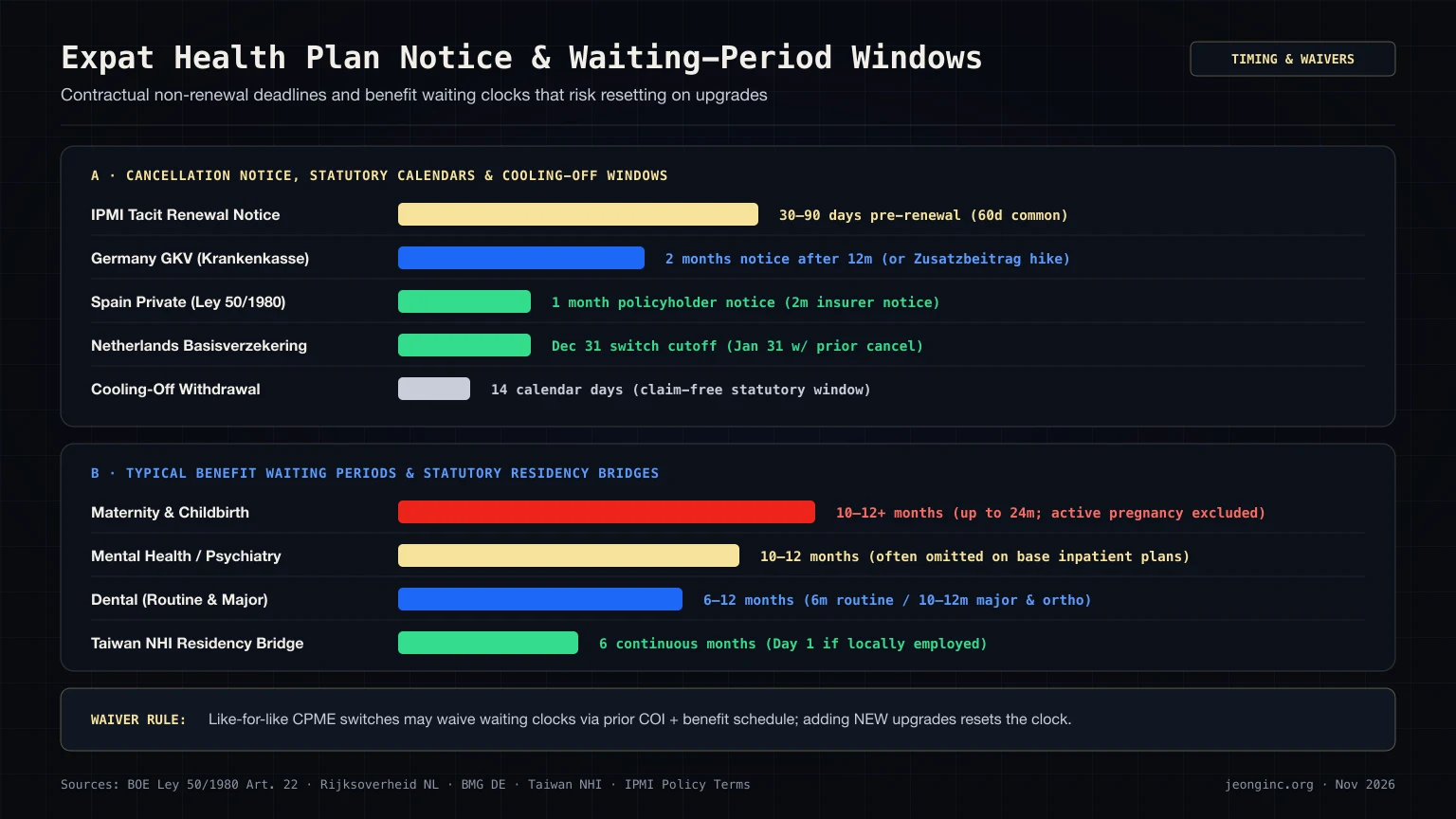
- 30-to-90-Day Tacit Renewal Cutoffs: Most annual IPMI contracts require written non-renewal notice 30 to 90 days before expiry (60 days is common on comprehensive global plans). Insurers sometimes deliver renewal rate quotes close to—or after—that cutoff, so calendar a reminder at Day -90 to preserve leverage.
- Mid-Term Cancellation Restrictions: Annual contracts rarely allow penalty-free mid-year exit simply for a cheaper competitor quote. Mid-term cancellation typically requires a documented qualifying event (such as relocating outside your Area of Cover, repatriating home, or joining a mandatory local scheme) and may otherwise forfeit unearned premium or trigger full-year balance liability.
- The 14-Calendar-Day Cooling-Off Window: EU, UK, and Spanish distance-sold health policies generally grant a 14-calendar-day withdrawal window from policy inception if zero claims have been submitted (occasionally minus administrative fees). Never treat cooling-off as a visa bridge—consulate approvals often take longer than 14 days.
Host-Country Statutory Switching Calendars (NL, DE, ES, TW)
If your health plan is a regulated domestic policy or you are transitioning between international and local public healthcare, local statutory calendars override generic IPMI dates:
| Jurisdiction & System | Mandatory Notice / Switch Window | Critical Operational Rule |
|---|---|---|
| Netherlands Basisverzekering |
Switch by December 31 (or cancel yourself by Dec 31 and pick new plan by January 31). | Signing with a new Dutch insurer by Dec 31 auto-cancels the old one; cancelling by Dec 31 grants until Jan 31 with retroactive Jan 1 cover (Rijksoverheid). |
| Germany GKV Statutory Funds |
12-month initial tie, then 2 months' notice to end of month after next. | If your Krankenkasse raises its Zusatzbeitrag (supplemental rate), a legal Sonderkündigungsrecht lets you bypass the 12-month lock-in with 2 months' notice (BMG). |
| Spain Private Health (Ley 50/1980) |
1 month written notice from policyholder; 2 months from insurer before expiry. | Under Ley 50/1980 Art. 22, missing the 1-month written deadline auto-renews the contract for another full year. Use traceable written proof. |
| Taiwan National Health Insurance (NHI) |
Mandatory enrollment after 6 continuous months on an ARC / Gold Card (or Day 1 if locally employed). | Only one trip abroad under 30 days is permitted during the 6-month clock (stays pause/reset above 30 days). Keep a 6-month private IPMI bridge active until your NHI card is issued (Taiwan Gold Card). |
Which Waiting Periods Transfer vs. Reset
Emergency inpatient care typically begins on Day 1, but planned and ancillary modules enforce strict waiting clocks on new policies: 10 to 12+ months (sometimes up to 24 months) for maternity, 10 to 12 months for mental health and psychiatry, and 6 to 12 months for dental (typically 6 months for routine care and 10 to 12 months for major restorative or orthodontics). When switching like-for-like under CPME with unbroken prior coverage, submit your prior Certificate of Insurance and Table of Benefits to request a written waiting-period waiver. However, if you add a maternity or dental module you did not hold previously—or if pregnancy has already begun—waivers are refused and full waiting periods or pre-existing exclusions apply.
4. Switching for Visa Compliance & Upgrading From Travel Medical
Upgrading from travel medical insurance (such as SafetyWing or World Nomads) to a true expat health plan—or switching between private policies while holding a residency permit—requires verifying visa wording and hospital payment mechanics before binding. Travel policies rarely grant CPME transfer rights into comprehensive IPMI, and most immigration offices reject policies with deductibles or annual caps.
Why Travel Medical Fails Long-Term Residency & Hospital Admissions
As detailed in our Expat Health vs. Travel Medical Guide and Expat & Nomad Insurance Playbook, travel medical policies are built to stabilize and evacuate you back to your home country ("fit to fly"), not fund multi-year oncology or chronic care abroad—and many require active home-country public health eligibility (such as Canadian provincial GHIP). Major international hospitals also demand substantial credit card deposits until an insurer transmits a verified inpatient Guarantee of Payment (GOP); keep multi-currency emergency liquidity ready using our Expat Banking Stack and always decline Dynamic Currency Conversion (DCC) at hospital payment terminals.
4 Destination Visa Rules to Verify Before Switching Plans
- Spain (Digital Nomad & Non-Lucrative Visas): Immigration offices require private coverage from a DGSFP-authorized insurer operating in Spain with zero copays (sin copago), zero deductibles (sin franquicia), and comprehensive benefits matching Spain's public SNS without waiting periods or annual caps. Never switch onto a high-deductible IPMI plan while renewing a Spanish residency permit unless you have transitioned into Spanish Social Security (RETA/employee).
- Portugal (D8 Digital Nomad Visa & AIMA): Consulates typically demand valid travel/medical coverage for the initial 120-day entry visa before AIMA residency and SNS public registration complete; switching plans mid-AIMA backlog requires preserving continuous certificate dates matching your lease and NIF filings.
- Thailand (DTV, LTR & Non-Immigrant O-A/O-X): While DTV applicants face minimal statutory medical-policy mandates at filing, Long-Term Resident (LTR) visas require at least $50,000 USD in medical coverage (or qualifying financial assets), whereas Non-Immigrant O-A retirement visas and extensions enforce at least $100,000 USD (3,000,000 THB) backed by an OIC-compliant Foreign Insurance Certificate. Verify that any replacement plan issues the exact Thai OIC certificate template if holding a retirement-class visa.
- Taiwan (Employment Gold Card & ARC): Maintain continuous private international coverage throughout your 6-month continuous residency period until your NHI card is active (unless employed by a local Taiwanese entity, which enrolls you on Day 1); do not cancel your private bridge policy before physically collecting your NHI card.
5. Notice-Cutoff Expat Health Plan Switching SOP (Day -120 to Day +1)
Execute plan evaluations and carrier switches in a strict sequence anchored to your current policy's written non-renewal cutoff (Tnotice, typically 30 to 90 days before renewal). Securing Policy B's written underwriting offer before Tnotice prevents involuntary 12-month auto-renewal, while binding at Day -2 with a 48-hour overlap eliminates timezone cutoffs, retroactive grace-period lapses, and CPME disqualifications.
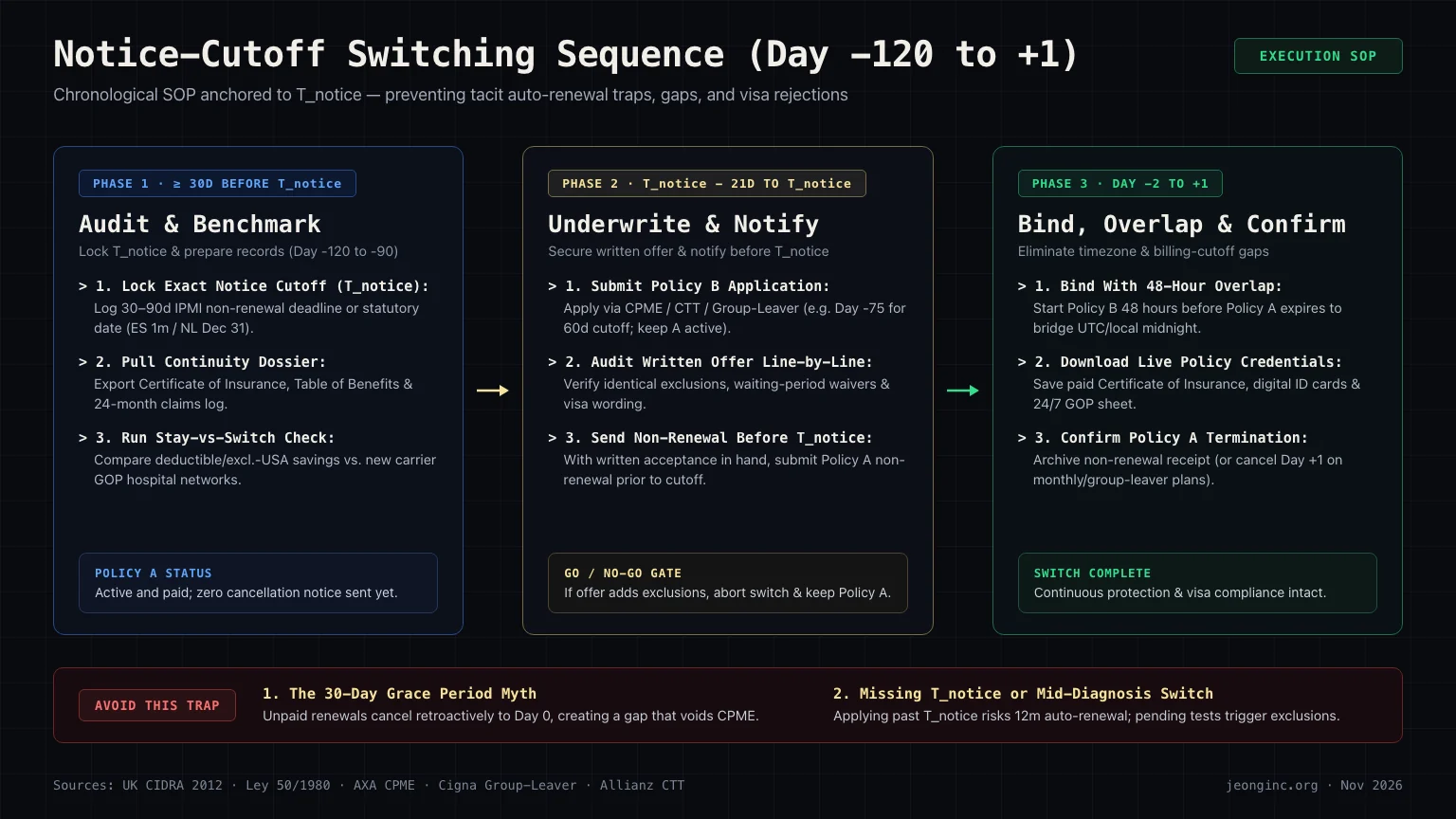
Phase 1A (Day -120 to -90 / ≥ 30 Days Before Tnotice): Lock Notice Cutoff & Pull Continuity Records
- Confirm your policy's exact written non-renewal cutoff Tnotice (e.g., Day -60 or Day -90 on annual IPMI, Day -30 in Spain under Ley 50/1980 Art. 22, or December 31 in the Netherlands).
- Download your current Certificate of Insurance (COI) showing original inception date and underwriting basis (FMU, CPME, or Moratorium), your full Table of Benefits, and a 24-month claims log.
- Confirm you have no open pre-authorizations, pending biopsies, or scheduled procedures—never switch carriers mid-diagnosis.
Phase 1B (≥ 30 Days Before Tnotice): Benchmark Stay-and-Restructure vs. Switch Quotes
- Ask your current carrier for renewal restructuring quotes (higher deductible, Worldwide Excluding USA, or inpatient-only) and confirm in writing that downgrading triggers zero fresh medical underwriting.
- Request like-for-like switch quotes from competing carriers (e.g., AXA CPME, Allianz CTT, Cigna CPME/Group Leaver) and verify Guarantee of Payment (GOP) direct-billing partnerships at your city's top hospitals.
Phase 2A (Tnotice − 21 to −14 Days): Submit Policy B Application (Keep Policy A Active)
- Submit your Policy B CPME, Continued Moratorium, Group-Leaver Continuation (within Cigna's 30-day window after 6 months of group tenure), or FMU application with complete medical disclosure early enough to receive a written decision before Tnotice (for example, around Day -75 for a 60-day cutoff or Day -45 for a 30-day cutoff).
- Do not send cancellation or non-renewal notice to Policy A yet—keep Policy A active and paid while underwriting runs.
Phase 2B (Before Tnotice): Audit Written Offer & Submit Policy A Non-Renewal Notice
- Audit Policy B's written underwriting offer line by line: confirm prior exclusions match identically, check for unexpected premium loadings, verify any waiting-period waivers (dental/maternity) or CMORI clock credits in writing, and confirm residency visa wording (such as Spain's sin copago / sin franquicia or Thailand's OIC certificate format).
- Once unconditional written acceptance is in hand—and strictly before Tnotice—submit Policy A's formal written non-renewal notice and archive the timestamped confirmation receipt.
- Fallback for monthly/no-notice plans or late renewal quotes: If you hold a rolling monthly or employer-leaver policy with no annual tacit-renewal cutoff, or if Policy A delivers its renewal rate after Tnotice has passed, confirm in writing whether your carrier grants a post-quote non-renewal extension or 14-day statutory cooling-off exit before cancelling Policy A.
Phase 3 (Day -2 to Day +1): Bind With 48-Hour Overlap & Confirm Policy A Termination
- Bind Policy B effective Day -2 (48 hours prior to Policy A's expiration date) so international time-zone boundaries cannot create a 1-day gap.
- Download Policy B's paid Certificate of Insurance, active digital membership card, and 24/7 GOP assistance sheet; never rely on a 30-day payment grace period on Policy A as a free bridge (unpaid renewals cancel retroactively to Day 0).
- Confirm Policy A's scheduled non-renewal / termination receipt in your archive—or execute Day +1 written cancellation on rolling monthly or employer-leaver policies once the 48-hour overlap clears.
6. Verified Primary Sources & Statutory References
Every underwriting transfer path, statutory notice deadline, disclosure statute, and residency healthcare rule in this guide was verified directly against insurer documentation and government portals in November 2026.
Insurers, Statutory Health Authorities & Insurance Law
Audited Nov 2026Official global health portals for AXA Global Healthcare (CPME), Cigna Global (CPME & Group Leaver), Allianz Care (CTT), and Bupa Global.
UK Consumer Insurance (Disclosure and Representations) Act 2012, UK Financial Conduct Authority (FCA), and EU Insurance Authority (EIOPA).
Ley 50/1980 Art. 22 (1-month policyholder / 2-month insurer notice) and Spain Directorate-General for Insurance & Pension Funds (DGSFP).
Dutch Government calendar-year switching rules (Dec 31 / Jan 31) and German Federal Ministry of Health statutory GKV rules.
Taiwan Employment Gold Card healthcare & 6-month NHI portal, and Thailand Office of Insurance Commission (OIC) regulatory hub.
7. Frequently Asked Questions on Switching Expat Health Plans
Concise, regulator-grounded answers to the underwriting, notice-window, waiting-period, and visa questions expats face when changing health plans.
Can I switch expat health plans without losing coverage for pre-existing conditions?
Yes, if you qualify for Continued Personal Medical Exclusions (CPME) or Continuous Transfer Terms (CTT) on an equivalent or lower benefit tier with unbroken prior coverage, or a Group-Leaver Continuation plan when exiting an employer scheme. Conditions that developed while insured on your prior plan carry over as covered, while prior personal exclusions remain mirrored.
When is it smarter to modify my existing health plan instead of switching carriers?
Staying and restructuring your existing policy is usually safer if you have an active chronic condition, take daily maintenance medication, or are mid-treatment or awaiting diagnostic results. Raising your annual deductible, shifting from Worldwide Including USA to Worldwide Excluding USA, or trimming outpatient riders with your current insurer typically avoids fresh medical underwriting.
How do Cigna Global, AXA Global Healthcare, Allianz Care, and Bupa Global handle switches?
AXA Global Healthcare offers CPME switch underwriting for applicants under age 80 with at least 12 months of continuous prior cover that ended within the last 90 days. Allianz Care supports Continuous Transfer Terms (CTT) and CPME for equivalent or lower cover upon receiving prior certificates and benefit schedules. Cigna Global offers CPME switch options plus a Group Leaver Continuation track requiring at least 6 months on a corporate plan and application within 30 days of termination, while Bupa Global generally evaluates individual pre-existing conditions through full medical underwriting or case-by-case review rather than a standard open-market CPME channel.
Do waiting periods for maternity, dental, or mental health reset when I switch plans?
Yes, unless you obtain a written waiting-period waiver on a like-for-like switch. Standard individual IPMI plans commonly enforce 10 to 12+ months (and up to 24 months) for maternity, 6 to 12 months for routine and major dental, and 10 to 12 months for mental health care. Adding a benefit module you did not hold previously—or already being pregnant—triggers full waiting clocks or pre-existing exclusions.
How far in advance must I give notice before switching expat health plans?
Most international private medical insurance contracts renew automatically unless written notice arrives 30 to 90 days before renewal (60 days is common). Statutory systems enforce strict calendars: Spanish private contracts require 1 month policyholder notice under Ley 50/1980 Article 22, the Netherlands requires switching by December 31 (or cancelling by December 31 to choose by January 31), and German statutory GKV funds require 2 months notice after 12 months of tenure unless triggered earlier by a Zusatzbeitrag hike.
Does a 30-day payment grace period bridge coverage while I switch insurers?
No. A premium grace period only prevents cancellation if you pay the renewal invoice for that same existing policy. If you let the grace period expire unpaid while moving to another insurer, the old policy terminates retroactively to Day 0, creating a retroactive lapse that can void CPME eligibility and reset Moratorium clocks.
Can I switch from travel medical insurance like SafetyWing to a full expat health plan mid-trip?
You can apply for an International Private Medical Insurance (IPMI) plan at any time while abroad under Full Medical Underwriting or Moratorium terms, because travel medical policies generally do not grant CPME transfer rights into comprehensive IPMI. Any condition diagnosed while holding a short-term travel medical policy will be evaluated as pre-existing on your new IPMI application, and travel policies rarely satisfy long-stay residency visa rules such as Spain's sin copago requirement.

Written by Kevin Jaewoong Jeong
Founder of Jeong Inc. Researches cross-border health coverage architecture, banking infrastructure, and statutory relocation operations. Jeong Inc. is an independent software and research company, not an insurance broker or underwriter. For educational purposes only; confirm live policy wording, underwriting eligibility, and visa rules with qualified professionals.