eSIMs for Remote Teams: IT, Ops & HR Buying Guide
eSIMs for remote teams are centrally managed digital cellular profiles that let distributed employees land connected across 160 to 200+ destinations under one corporate billing account, hard spend caps, and MDM lifecycle controls—eliminating plastic SIM logistics, $12–$18/day carrier roaming shocks, and scattered travel expense receipts. To match the right platform to your travel cadence: ad-hoc multi-country teams avoid unused data waste with Roamless for Business non-expiring credits or Airalo / Saily corporate wallets; heavy daily travelers (>16 days/month) fit Holafly for Business flat-rate plans; strict budget-capped fleets use GigSky circuit breakers; regulated fleets needing native voice, SMS, and Jamf/Intune EID push use 1GLOBAL Enterprise; and cellular laptop fleets use Ubigi for Business.
Why Consumer Travel eSIMs and Carrier Day Passes Fail Every Team Stakeholder
Most remote organizations inherit travel connectivity by accident—employees either leave domestic SIM roaming on at $12 USD to $18 CAD per day, or buy random consumer eSIMs and submit screenshots in Expensify. Four operational failures surface immediately once headcount crosses 10 traveling staff:
- Finance & Ops (Bill Shock & VAT Chaos): A 15-person offsite on carrier roaming passes quickly burns $2,000+ in avoidable fees, while individual consumer eSIM receipts lack consolidated VAT invoicing and leave expired 7-day data buckets ("data breakage").
- IT & Security (Public Wi-Fi Exposure & Offboarding Leaks): When staff lack reliable cellular tethering, they default to hostile airport or hotel Wi-Fi—or wipe corporate devices without preserving or revoking assigned cellular plans.
- HR & People Ops (Arrival Friction): Asking new hires or offsite attendees to queue at airport SIM kiosks or pay out-of-pocket creates Day-1 onboarding drag.
- Remote Team Leads (Tethering & 2FA Dropouts): Consumer "unlimited" tourist eSIMs cap hotspots and throttle speeds mid-call, while naive Single-SIM swaps break Okta and bank 2FA SMS codes.
Table of Contents — eSIMs for Remote Teams Guide
1. The Corporate Roaming Math: Why Day Passes & Expense Reports Fail
Global business travel spending grew 8.4% in 2025 to $1.59 trillion and is projected by the Global Business Travel Association (GBTA) to climb +7.2% to $1.71 trillion USD in 2026 across more than 1.84 billion trips, while Juniper Research forecasts 1.5 billion active eSIM connections globally in 2026 (+30% year over year). Yet a Deloitte compliance benchmark shows only 34.6% of organizations maintain a formal travel/remote compliance policy, leaving 45.9% to manage cross-border logistics with lean 1-to-2 person teams—and legacy North American carrier roaming passes punish that gap on every billing cycle.
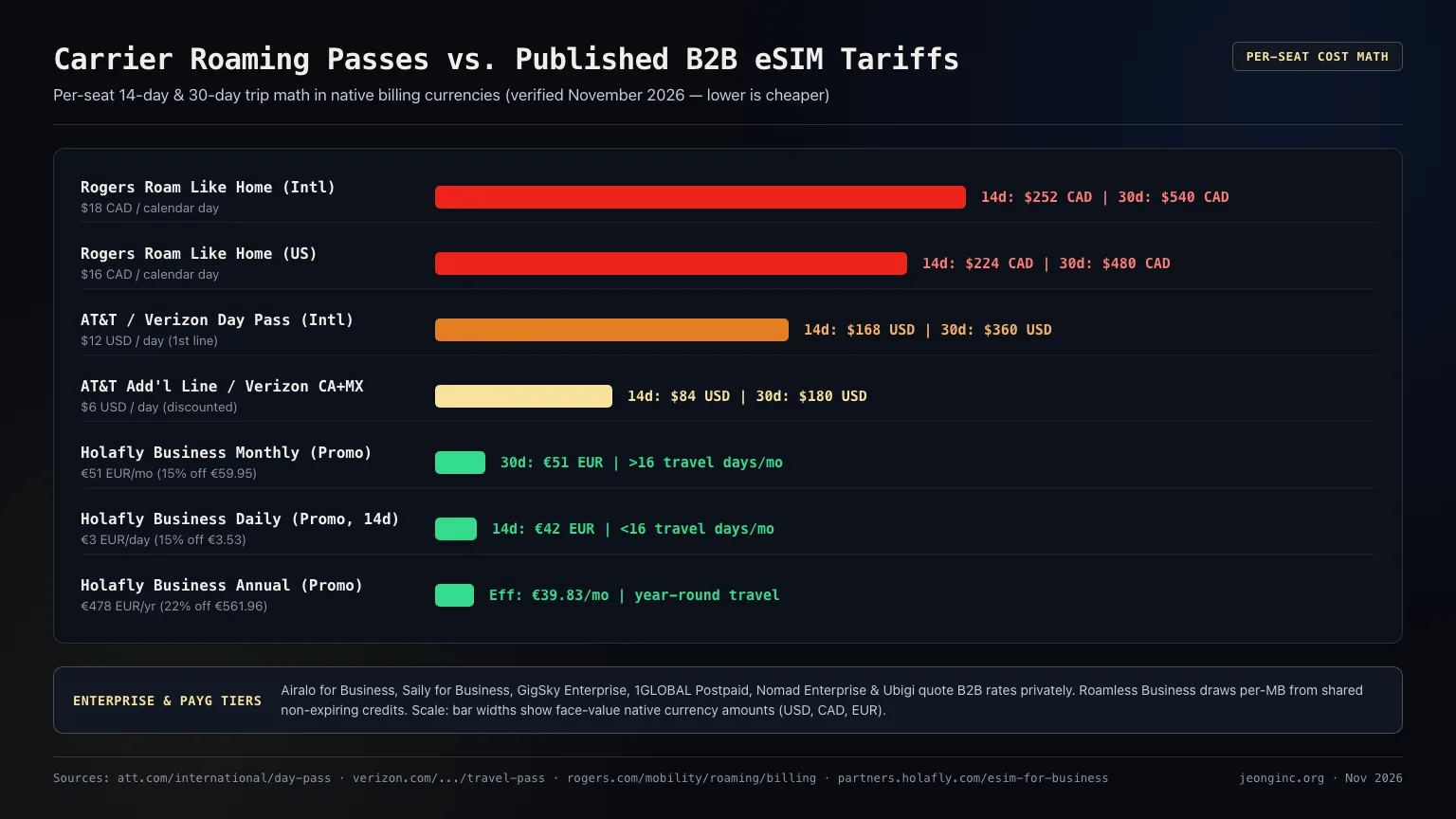
Checked directly against carrier tariff schedules as of November 2026, legacy roaming rates escalate linearly with every calendar day a device registers background packets abroad:
- AT&T International Day Pass: Charges $12 USD/day for the first line ($6/day per additional line on the same calendar day) across 210+ destinations, and $20/day on cruise ships. A single 14-day trip costs $168 USD; 30 days costs $360 USD per primary seat.
- Verizon TravelPass: Charges $12 USD/line per day in 210+ countries ($6/line per day in Canada and Mexico)—identical $168 USD (14-day) and $360 USD (30-day) exposure overseas.
- Rogers Roam Like Home (Canada): Bills $16 CAD/calendar day in the US and $18 CAD/calendar day internationally—and Rogers explicitly notes that roaming in both the US and another destination within one calendar day triggers both charges ($34 CAD in 24 hours). Fourteen days internationally reaches $252 CAD; 30 days hits $540 CAD per seat.
Why Legacy Workarounds Disappoint Finance and Operations
Teams that abandon carrier passes without adopting a central B2B eSIM console usually fall into three broken alternatives: pocket Wi-Fi (MiFi) pucks create hardware shipping, battery-decay, and airport return bottlenecks; ad-hoc consumer eSIM reimbursements generate dozens of inconsistent receipts without consolidated VAT invoices and leave unused gigabytes in fixed 7-day data buckets (data breakage—for example, consuming 1.5 GB of a prepaid 5 GB pack before flying home early); and consumer "unlimited" tourist eSIMs enforce hidden Fair Usage Policy (FUP) throttles and tight tethering caps that halt laptop video calls mid-sprint.
2. B2B eSIM Platforms Compared: Verified Pricing, Billing & Specs
Unlike consumer travel eSIM comparison lists, enterprise and distributed-team platforms differ primarily on billing architecture, identity lifecycle (SSO/SCIM), MDM push, and hotspot/voice rules. Every figure in the matrix below reflects primary vendor documentation audited in November 2026; platforms that negotiate rates privately by volume are marked honestly as Custom quote rather than guessing per-gigabyte estimates.
| B2B Platform | Verified Pricing & Billing Model | Coverage & Profile Type | Hotspot, Voice & Hardware | IT, MDM & Security Controls | Best-Fit Team Archetype |
|---|---|---|---|---|---|
| Airalo for Business | Custom quote (Airalo Partners). Reported $0 monthly platform fee; prepaid wallet credits & postpaid consolidated monthly invoicing; spend caps. | 200+ destinations (local, regional, global); data-only + select voice/text packages. | Unrestricted hotspot on standard fixed-data plans; 24/7 multilingual support. | SSO & SCIM auto-onboarding/offboarding; multi-level cost centers; auto top-ups; GDPR, SOC 2 Type II, PCI DSS. | Mid-to-large remote teams wanting Okta/Entra SCIM automation and broad global catalog depth. |
| Holafly for Business | Published promos: €3/day (15% off €3.53/d, <16d/mo), €51/mo (15% off €59.95, >16d/mo), €478/yr (22% off €561.96); Custom quote (20+ seats). Single monthly VAT invoice. | 160+ destinations; global unlimited data eSIM. | Official business page states "All data can be shared via a hotspot"; exact business FUP GB thresholds are not publicly disclosed. | Centralized admin assignment panel (email/phone or batch CSV); 24/7 multilingual support. | Frequent travelers (>16 days/mo) and HR/finance teams wanting predictable flat EUR billing and VAT invoices. |
| Saily for Business | Custom quote (rates inside business portal). Pay-only-for-what-you-use billing with automated invoicing. | 200+ destinations (country, regional, global); data-only (optional US number add-on). | Dual-SIM primary number retention; auto-activation on arrival; 24/7 chat + dedicated account manager. | Built by Nord Security (NordVPN team) with centralized team management and security-first positioning. | Security-conscious SMBs and distributed engineering teams already standardized on Nord Security tools. |
| GigSky Business / Enterprise | Self-service prepaid wallet (zone-based PAYG) or Enterprise Custom quote with consolidated postpaid invoicing. | 200+ destinations across 800+ carrier partners with automatic notspot fallback. | Pooled team data across devices; per-employee and per-trip hard caps. | Automated "circuit breakers" stop excess usage immediately; enterprise custom networking options. | Finance controllers demanding strict per-trip GB circuit breakers and multi-carrier fallback. |
| 1GLOBAL Enterprise | SmartEnterprise (prepaid data) & Enterprise Postpaid (Custom quote monthly/annual contracts, consolidated billing). | 190+ countries (600+ carrier networks; 160+ on SmartEnterprise). Full Voice, SMS & Data + native numbers in 10+ countries. | Full enterprise telephony + data; optional Device-as-a-Service (DaaS) procurement. | GSMA-certified MVNO owning core network; MDM EID preload & zero-touch push (Jamf Pro, Intune), Apple Lookup Service, Apple Quick Transfer, compliance call recording. | Regulated enterprises (finance, legal, healthcare) needing zero-touch MDM push, native voice/SMS, and audit recording. |
| Roamless for Business | Shared company wallet (Roamless Credits / FLEX); per-MB PAYG drawdown (credits never expire). Corporate rates inside portal. | Single Global eSIM™ ("install once, connect anywhere") across 200+ destinations. | Hotspot/tethering supported; in-app global voice calls + optional secondary numbers. | Centralized funding and automated onboarding/policy assignment for new joiners; zero expired-bucket breakage. | Sporadic or multi-hop travelers who hate reinstalling per-trip eSIMs or losing unused 7-day data buckets. |
| Nomad Enterprise | Prepaid credits or consolidated monthly invoicing with volume discounts (Custom quote). | 200+ destinations (local, regional, global data eSIMs). | Unrestricted tethering on fixed data buckets; automated invoice generation. | Built on LotusFlare telecom infrastructure; centralized web console, usage tracking, and APIs/SDKs. | Ops teams or travel platforms wanting programmatic API/SDK automation alongside a standard team console. |
| Ubigi for Business | Custom quote business/fleet plans with centralized SIM management portal. | 200+ destinations on a single reusable global eSIM profile. | Native support for eSIM-enabled Windows laptops, tablets & mobile hotspots plus smartphones. | Backed by Transatel (NTT); centralized fleet allocation and usage reporting. | Field teams and remote engineers running cellular-capable Windows laptops or iPads without phone tethering. |
Specialist & API Alternatives: Engineering-led travel apps or SaaS products embedding connectivity directly into internal employee apps also evaluate white-label API/SDK providers such as Celitech (215+ countries, SOC 2, quote-only), while lightweight startups seeking simple weekly team passes sometimes review Simology, KnowRoaming, or hard-stop overage-free Breeze.
3. Choosing Your Procurement Model (4-Way Decision Matrix)
The single biggest mistake Finance and IT teams make is picking a vendor before choosing a billing architecture. Matching your team's trip cadence to the wrong billing model creates either 50% unused-data waste ("breakage") or unexpected Fair Usage throttling during client sprints.
Non-Expiring Per-MB Credits
Fund one corporate wallet (e.g., Roamless for Business). Staff install one persistent Global eSIM once; credits draw per megabyte only while abroad and never expire.
Best for: Irregular multi-city trips (1–7 days) with zero data breakage.
Fixed Buckets + Spend Caps
Assign country/regional fixed GB packages (5 GB–50 GB) with SSO/SCIM, cost centers, and hard circuit breakers (Airalo, Saily, GigSky, Nomad).
Best for: Predictable 1–3 week offsites & controlled per-trip budgets.
Predictable Monthly / Annual
Flat-rate recurring seats (Holafly for Business at €3/day, €51/mo, or €478/yr promos) with one monthly VAT-ready invoice for staff traveling >16 days/month.
Best for: Always-moving sales/exec travelers; confirm FUP terms for heavy video.
MDM Push + Voice & SMS
Full enterprise MVNO stack (1GLOBAL Enterprise) combining Jamf/Intune EID zero-touch activation, native local numbers, and compliance recording.
Best for: Corporate-owned iPhone/Android fleets & regulated industries.
When a Monthly Stipend + Local SIM Beats Any B2B eSIM (30+ Day Relocations)
Do not force traveling B2B eSIM tariffs onto employees staying in one hub (such as Bangkok, Ho Chi Minh City, Lisbon, or Madrid) for 30 days or longer. Domestic carriers in Southeast Asia and Europe typically offer 50 GB–150 GB of native 5G with 15 ms Local Breakout latency—plus a local phone number required for Grab drivers, Bizum transfers, or bank KYC—at 50% to 85% lower cost per gigabyte than roaming eSIMs. Use your B2B eSIM for Day-1 airport landing and multi-country sprints, and check our Solo Travel eSIM & Local SIM Benchmark for country-by-country rates (remembering that the UK and Switzerland sit outside EU Roam-Like-At-Home, so cross-border European trips still need regional coverage).
4. IT & Security Architecture: Zero-Touch MDM, BYOD vs. COPE & VPN Gaps
For IT and Security leads, eSIMs for remote teams solve two distinct risks simultaneously: keeping endpoints off untrusted public Wi-Fi and locking cellular provisioning to supervised device identity instead of stealable plastic SIM cards. Under the GSMA SGP.21 architecture, eSIM profiles are cryptographically bound to the device's hardware eUICC chip and cannot be physically popped out or cloned—a major win against SIM-swap theft and hardware loss.
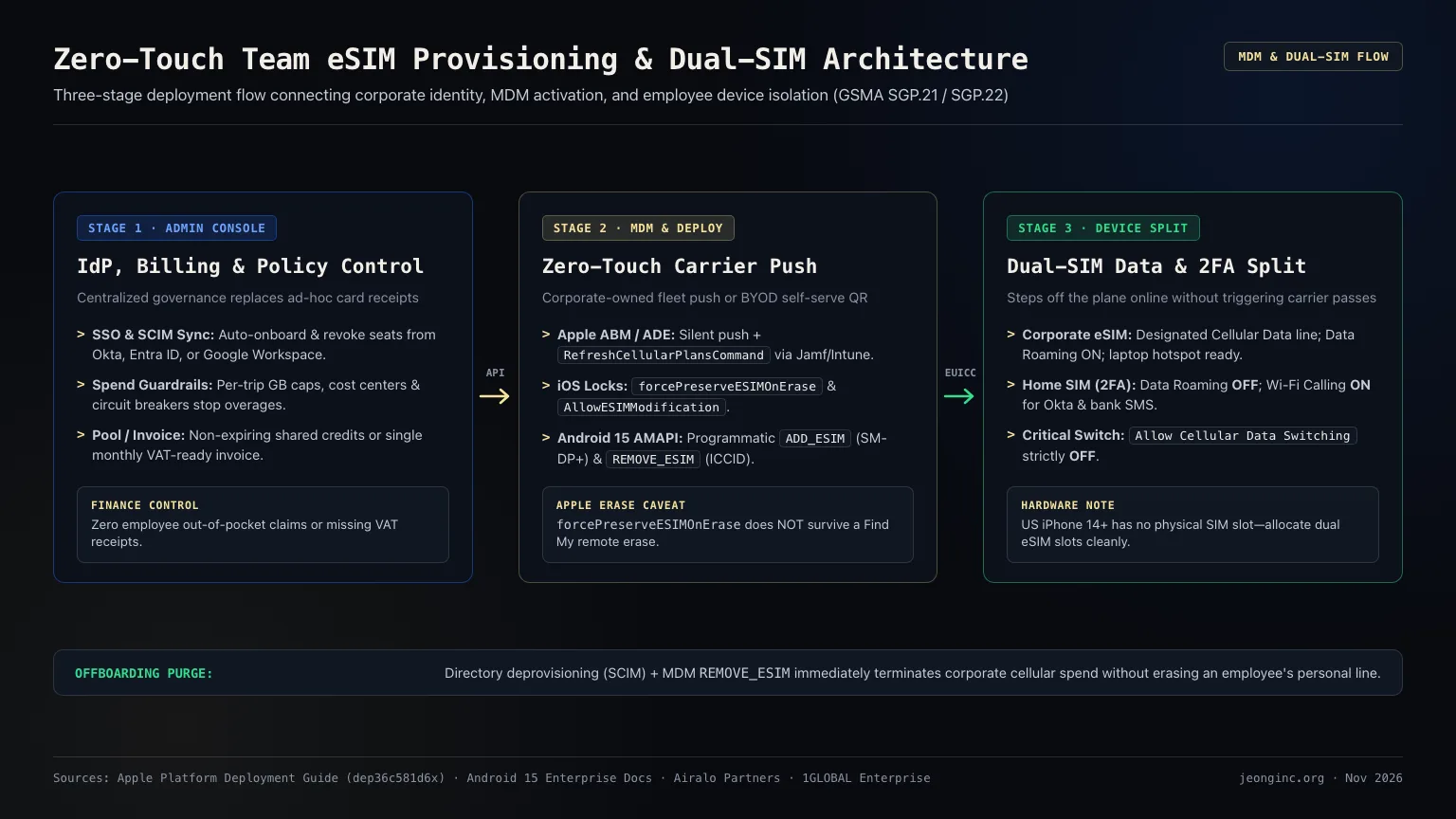
The security urgency is backed by two recent benchmarks: the UK Government's Cyber Security Breaches Survey 2025 found that 43% of businesses experienced a breach or attack in the prior 12 months—and while 64% enforce remote or mobile working policies, only 31% of businesses have a VPN for staff connecting remotely. Meanwhile, IBM's 2026 Cost of a Data Breach Report places the global average breach cost at $4.99 million USD (rising to $6 million for AI-enabled malicious breaches). Giving every traveling employee instant, company-funded 4G/5G cellular tethering eliminates the single biggest excuse for joining unencrypted airport, café, and hotel Wi-Fi networks.
Apple Business Manager (ABM / ADE) & iOS MDM Restrictions
Per Apple's Platform Deployment Guide, IT teams managing supervised iPhones and iPads through Jamf Pro, Microsoft Intune, or Kandji can automate cellular deployment during Automated Device Enrollment (ADE) and enforce three critical guardrails:
- Zero-Touch eSIM Carrier Activation &
RefreshCellularPlansCommand: Pushes the carrier eSIM silently during initial device setup or via MDM command using the SM-DP+ server address—no QR code printing or user tapping required. (Note that US-market iPhone 14, 15, 16, 17, and newer models ship eSIM-only with zero physical SIM tray, making disciplined eSIM slot management mandatory.) AllowESIMModification&Allow ESIM Outgoing Transfers(iOS 18+): Blocks employees on corporate-owned devices from deleting corporate profiles, adding unauthorized personal eSIMs, or transferring a work number to a personal phone via Quick Transfer.forcePreserveESIMOnErase(With Apple's Critical Caveat): Preserves the corporate cellular plan across user-initiated Erase All Content and Settings or failed-passcode wipes so IT can still locate and re-enroll the device. Crucial caveat: Apple explicitly documents that the system does not preserve an eSIM if an administrator initiates a remote wipe via Find My.
Android 15 Enterprise & Android Management API (AMAPI)
On company-owned Android devices, Android 15 Enterprise streamlines remote eSIM lifecycle control via the Android Management API (AMAPI). Admins issue programmatic ADD_ESIM commands with an SM-DP+ activation code (choosing ACTIVATED or NOT_ACTIVATED initial state) and run REMOVE_ESIM targeted by ICCID when an employee leaves or rotates off an assignment—terminating corporate spend without touching personal profiles on Dual-SIM handsets.
BYOD vs. Corporate-Owned (COPE) Policy Split
| Policy Dimension | Corporate-Owned (COPE / Supervised) | BYOD (Employee Personal Phone) |
|---|---|---|
| Activation Path | Zero-touch via Apple ABM/ADE, 1GLOBAL EID preload, or Android 15 AMAPI ADD_ESIM. |
Email QR code, universal install link, or vendor app activated via SSO (Okta / Entra / Google). |
| Offboarding Revocation | MDM REMOVE_ESIM / plan deletion + SCIM directory deprovisioning. |
SCIM deprovisioning + billing console line suspension (never wipe personal device data). |
| Hardware Lock Risk | Procure factory carrier-unlocked hardware globally; US iPhone 14+ has dual eSIM slots only. | Require employee carrier-unlock check (No SIM restrictions) 72 hours pre-flight. |
| 2FA & Privacy Boundary | Separate corporate eSIM for work data; keep personal 2FA off company-managed lines where possible. | Corporate eSIM handles travel Cellular Data only; employee's personal SIM stays intact for voice/2FA. |
5. Remote Work Reality: Hotspots, S8HR Latency & Dual-SIM 2FA
Provisioning an eSIM on paper is easy; keeping a distributed engineering or sales team productive over cellular tethering requires understanding three telecom mechanics that vendor brochures gloss over: laptop hotspot bandwidth, S8 Home Routing (S8HR) latency, and Dual-SIM 2FA leakage.
Hotspot Bandwidth, FUP Throttling & S8HR Latency
A remote team lead running sustained HD video calls, screen sharing, and cloud IDE or repository syncs on a tethered laptop can quickly exhaust small travel buckets. Fixed-bucket and PAYG B2B platforms (Airalo, Saily, GigSky, Roamless, Nomad, 1GLOBAL) let laptops tether freely up to your purchased gigabyte cap. On flat-rate plans, Holafly's business plan specification confirms "All data can be shared via a hotspot," though undisclosed carrier Fair Usage Policies (FUP) can still apply on extreme multi-gigabyte bursts—meaning teams running heavy continuous cloud backups should verify pilot throughput in-region or keep a fixed-GB secondary line as failover.
Equally important for developers using SSH, remote desktops, or real-time voice: many low-cost travel eSIMs route traffic via S8 Home Routing (S8HR) back to a distant home packet gateway (e.g., Hong Kong, Singapore, or Warsaw) before hitting the public internet, adding 120 ms to 450 ms of round-trip latency compared to 15 ms–40 ms on Local Breakout (LBO) domestic carrier SIMs. On metered tethered links, lightweight local-first tooling also matters: using D³ Drive Directory Duplicator copies Google Drive folder structures without downloading gigabytes over a cellular hotspot, and Antigravity Status Meter checks AI API quota limits natively without heavy browser reloads.
The Mandatory Dual-SIM + VoWiFi 2FA Pre-Flight Setup
Never instruct staff to port their primary mobile number to a VoIP app like Google Voice or TextNow before traveling—banking and enterprise SMSC lookups routinely block short-code 2FA SMS to VoIP numbers. Instead, enforce this four-step Dual-SIM configuration before every international flight (covered in depth for individual travelers in our Expat Phone, eSIM & Bank 2FA Guide):
- Confirm Carrier Unlock & Turn ON Wi-Fi Calling (VoWiFi): While still on home soil, verify the phone reads No SIM restrictions and activate Wi-Fi Calling with a valid E911 address on the primary home line.
- Install Corporate Travel eSIM on Home Wi-Fi: Keep the corporate eSIM switched OFF until landing (unless the provider auto-activates on destination tower handshake).
- Set Cellular Data to the Corporate eSIM & Disable Data Switching: On iOS/Android, set the corporate eSIM as the sole Cellular Data line, turn Data Roaming OFF on the home SIM, and turn Allow Cellular Data Switching (Auto Data Switching) strictly OFF.
- Never Answer Standard Cellular Voice Calls on the Home Line: Incoming 2FA SMS messages travel free or over Wi-Fi Calling/IMS Backup Calling; answering a cellular voice call or leaking 1 KB via Data Switching triggers a full $12 USD / $16–$18 CAD carrier day pass.
6. 30-Day IT, Ops & HR Rollout Checklist
Rolling out eSIMs for remote teams succeeds when IT, Finance, and HR execute hardware audits, billing guardrails, and employee pre-flight education in sequence before disabling legacy carrier roaming add-ons.
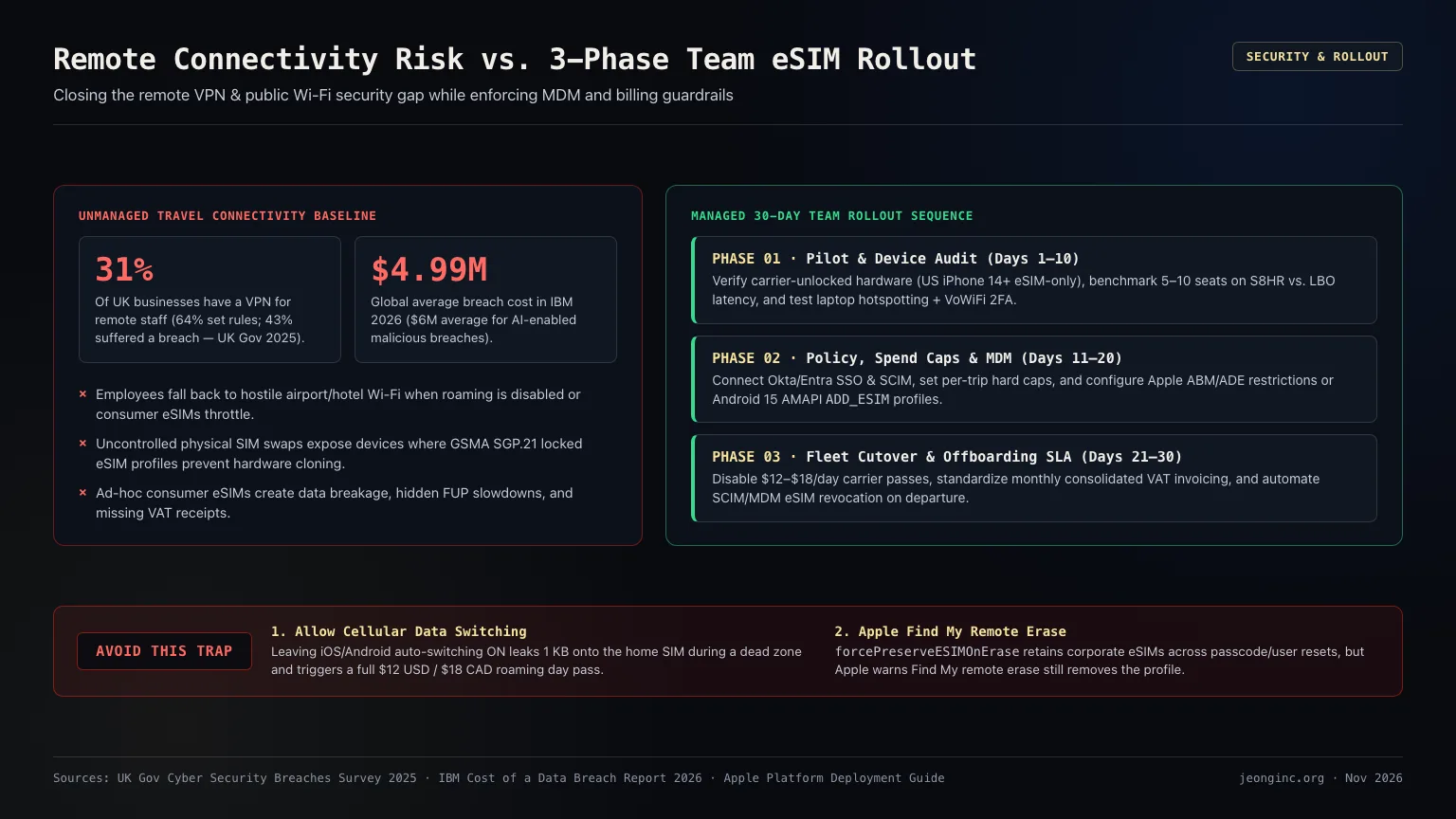
Phase 1 (Days 1–10): Hardware Audit & 5–10 Seat Corridor Pilot
- Inventory fleet devices for carrier locks and eSIM slot availability (remembering US iPhone 14+ models have no physical nano-SIM slot).
- Benchmark 5 to 10 frequent travelers across your top 3 corridors on hotspot reliability, S8HR ping on SSH/Zoom, and Dual-SIM VoWiFi 2FA receipt.
- Verify whether any staff staying 30+ days in one hub (e.g., Vietnam, Thailand, Spain, Portugal) should transition from B2B eSIMs to a local carrier stipend.
Phase 2 (Days 11–20): Billing Guardrails, SSO/SCIM & MDM Policy
- Connect Okta, Microsoft Entra ID, or Google Workspace via SSO/SCIM (where supported) and map cost centers for Finance reconciliation.
- Enable per-employee and per-trip GB/spend caps or automated circuit breakers, and lock corporate-owned devices via Apple ABM/ADE (
forcePreserveESIMOnErase,AllowESIMModification) or Android 15 AMAPI (ADD_ESIM). - Publish a one-page Slack/Notion pre-flight checklist emphasizing Allow Cellular Data Switching = OFF and banning unencrypted airport Wi-Fi for production access.
Phase 3 (Days 21–30): Carrier Pass Sunset & Offboarding SLA
- Remove automatic $12 USD / $16–$18 CAD daily roaming add-ons from corporate mobile accounts (or block international data roaming at the carrier portal).
- Switch Finance accounting from individual employee expense claims to one consolidated monthly VAT-ready invoice or shared corporate credit balance.
- Wire HR offboarding checklists to immediate SCIM revocation and MDM
REMOVE_ESIMprofile purging (avoiding Find My remote erase if eSIM preservation is required for hardware recovery).
7. Verified Primary Sources & Official Documentation
Every B2B vendor capability, EUR promotional rate, carrier roaming tariff, MDM configuration key, and cybersecurity statistic in this guide was verified directly against official vendor pages, carrier schedules, and government/industry studies in November 2026.
Primary Vendors, Carrier Tariffs, MDM Docs & Studies
Audited Nov 2026Official enterprise specs for Airalo Partners (SSO/SCIM, SOC 2), Holafly Business (€3/d, €51/mo, €478/yr, hotspot), Saily Business, and GigSky Business.
Official specifications for 1GLOBAL Enterprise, Roamless for Business non-expiring credits, Nomad Enterprise, and Ubigi for Business.
Official daily roaming tariffs: AT&T ($12/$6 USD), Verizon TravelPass ($12/$6 USD), and Rogers Roam Like Home ($16/$18 CAD).
Apple eSIM distribution, forcePreserveESIMOnErase (plus Find My caveat), and Android 15 Enterprise AMAPI ADD_ESIM/REMOVE_ESIM.
UK Gov Cyber Security Breaches Survey 2025 (43% breached, 31% remote VPN) and IBM 2026 Cost of a Data Breach ($4.99M avg; $6M AI-enabled).
GBTA $1.71T 2026 business travel forecast, Juniper 1.5B eSIM connections (+30% YoY), and Deloitte lean travel-compliance staffing survey.
8. Frequently Asked Questions on eSIMs for Remote Teams
Concise, primary-source answers to the procurement, MDM provisioning, tethering, and 2FA questions IT, Ops, HR, and team leads ask most often.
What is the best eSIM setup for remote teams?
No single billing model fits every travel pattern. Teams with sporadic multi-country travel avoid wasted data buckets with Roamless for Business's non-expiring shared credits or Airalo for Business and Saily for Business wallets; frequent travelers exceeding 16 days per month who need predictable flat billing evaluate Holafly for Business (€51/month promo); budget-capped enterprises use GigSky's automated circuit breakers; regulated fleets needing native voice, SMS, and Jamf/Intune EID push use 1GLOBAL Enterprise; and cellular laptop fleets use Ubigi for Business.
How much do B2B eSIMs save compared to AT&T, Verizon, and Rogers roaming passes?
Published carrier daily passes charge $12 USD per day on AT&T International Day Pass and Verizon TravelPass ($168 USD for 14 days or $360 USD for 30 days on a primary line) and $16 CAD (US) to $18 CAD (international) per calendar day on Rogers Roam Like Home ($252 to $540 CAD per seat). By comparison, Holafly for Business publishes promotional tiers at €3/day (€42 EUR for 14 days), €51/month, and €478/year (€39.83/month effective), while PAYG shared credits and custom-quoted enterprise pools avoid paying daily flat fees on idle days.
Can IT push and revoke corporate eSIMs automatically via MDM?
Yes, on supervised corporate-owned devices. Apple Business Manager Automated Device Enrollment and MDM servers (such as Jamf Pro or Microsoft Intune) support eSIM Carrier Activation, RefreshCellularPlansCommand, AllowESIMModification, and forcePreserveESIMOnErase (though Apple documents that Find My remote erase still deletes the eSIM). On Android 15 company-owned devices, the Android Management API supports programmatic ADD_ESIM via SM-DP+ codes and REMOVE_ESIM by ICCID. On BYOD personal phones, teams typically distribute QR codes or deep links via email or self-service portals.
Do business eSIMs allow laptop hotspotting without throttling?
Fixed-bucket and pay-per-MB business platforms (Airalo for Business, Saily for Business, GigSky, Roamless, Nomad Enterprise, and 1GLOBAL) permit laptop tethering up to your allocated data pool without artificial daily hotspot sub-caps. For flat-rate plans, Holafly's business plan page states that all data can be shared via a hotspot, whereas Holafly's consumer tourist eSIMs restrict hotspot sharing; however, Holafly does not publicly disclose exact business Fair Usage Policy gigabyte thresholds.
How do remote employees keep Okta and bank 2FA SMS abroad without triggering roaming fees?
Leave the employee's primary home SIM active for voice/SMS only, turn Data Roaming strictly OFF on that home line, enable Wi-Fi Calling before departure, set the corporate eSIM as the active Cellular Data line, and turn OFF Allow Cellular Data Switching (or Auto Data Switching). Leaving data switching enabled leaks background kilobytes onto the home SIM and triggers a full 24-hour $12 USD or $16 to $18 CAD carrier roaming pass.
Why are most B2B eSIM platforms marked custom quote?
Airalo for Business, Saily for Business, GigSky Enterprise, 1GLOBAL Postpaid, Nomad Enterprise, and Ubigi for Business negotiate per-gigabyte and zone pricing privately based on seat count, regional corridor mix, and SLA requirements rather than publishing public fixed rate cards. Only Holafly for Business publishes standardized daily, monthly, and annual EUR promotional pricing publicly (with 20+ seat Enterprise plans also custom-quoted).
When should a remote team choose local carrier SIMs and a stipend over a B2B eSIM?
When an employee relocates to a single country for 30 days or longer—or needs a domestic voice number for delivery apps, banking, or local ride-hailing—local carrier SIMs or eSIMs typically cost 50% to 85% less per gigabyte with native 15ms Local Breakout latency. Use B2B eSIMs for 1-to-30 day travel, multi-country sprints, offsites, and immediate airport arrival before local KYC completes.

Written by Kevin Jaewoong Jeong
Founder of Jeong Inc. Researches cross-border connectivity, B2B telecom infrastructure, and global relocation operations. For educational purposes only; confirm live enterprise pricing, tax invoicing, and MDM compliance with qualified professionals.